20  Text Analytics

Natural Language Processing is a vast subject requiring extensive study. The field is changing quickly, and advancements are being made at an extraordinary speed.

We will cover key concepts at a high level to get you started on a journey of exploration!

20.1 Some basic ideas

20.1.1 Text as data

Data often comes to us as text. It contains extremely useful information, and often what text can tell us, numerical quantities cannot. Yet we are challenged to effectively use text data in models, because models can only accept numbers as inputs.

Vectorizing text is the process of transforming text into numeric tensors.

In this discussion on text analytics, we will focus on transforming text into numbers, and using it for modeling.

The first challenge text poses is that it needs to be converted to numbers, ie vectorized, before any ML/AI can consume them.

One way to vectorize text is to use one-hot encoding.

Consider the word list below.

index word
1 [UNK]
2 i
3 love
4 this
5 and
6 company
7 living
8 brooklyn
9 new york
10 sports
11 politics
12 entertainment
13 in
14 theater
15 cinema
16 travel
17 we
18 tomorrow
19 believe
20 the

Using the above, the word ‘company’ would be expressed as:
> [0 0 0 0 0 0 1 0 0 0 0 0 0 0 0 0 0 0 0 0 0]

But how did we come up with this dictionary, and how would we encode an entire sentence?

20.1.2 Vectorizing Sentences as Sequences:

We build a dictionary of words from our corpus (corpus means a collection of documents), and call it the word index. We then use the word indexes to create a sequence vector by replacing each word in our given sentence by its corresponding word index number.

So “I love sports!” = [2, 3, 10] (Sentence 1)

And “I love living in Brooklyn and in New York and some sports” = [2, 3, 7, 13, 8, 5, 13, 9, 5, 1, 10] (Sentence 2)

20.1.3 Vectorizing with Document Term Matrices:

This can be expressed as a matrix, with the word index numbers along one axis, and the ‘documents’ along the other. This is called a ‘Document Term Matrix’, for example, a document term matrix for our hypothetical sentences would look as below:

image.png

Now this matrix can be used as a numeric input into our modeling exercises.

20.1.4 Tokenization

Think about what we did:
- We ignored case
- We ignored punctuation
- We broke up our sentences into words. This is called tokenization. The words are our ‘tokens’

There are other ways to tokenize.
- We could have broken the sentence into characters. - We could have used groups of 2 words as one token. So ‘I love sports’ would have the tokens ‘I love’ and ‘love sports’.
- We could have used 3 words as a token, so ‘I love living in Brooklyn’ would have the tokens ‘I love living’, ‘love living in’, and ‘living in Brooklyn’.

20.1.5 N-grams

Using multiple words as a token is called the n-gram approach, where n is the number of words.
- Unigram: When each word is considered a token (most common approach)
- Bigram: Two consecutive words taken together
- Trigram: Three consecutive words taken together

Bigrams, Trigrams etc help consider words together. When building the document term matrices, we ignored the word order, and treated each sentence as a set of words. This is called the ‘bag-of-words’ approach.

The transformer shift in NLP (2018–present): TF-IDF, bag-of-words, and Word2Vec are foundational concepts every practitioner should understand — and they remain the practical choice when data is small or interpretability is paramount. For most modern production NLP, however, pre-trained transformer models have become the default: - BERT (and its descendants RoBERTa, DistilBERT) — excellent for classification, NER, semantic similarity - Sentence Transformers (pip install sentence-transformers) — produce dense 768-dim sentence embeddings; cosine similarity between two embeddings often beats TF-IDF + classifier pipelines - GPT-4 / Claude / Llama 3 — generative models for open-ended text tasks, summarisation, and information extraction via prompting

The progression in this chapter — from TF-IDF → Word2Vec → embeddings — mirrors how the field evolved. Each step produces richer, more context-aware representations of text.

20.1.6 TF-IDF

TF-IDF = Term Frequency - Inverse Document Frequency
Generally when creating a Document Term Matrix, we would consider the count of times a word appears in a document.
However, not all words are equally important. Words that appear in all documents are likely less important than words that are unique to a single or a few documents.
Stopwords, such as of, and, the, is etc, would likely appear in all documents, and need to be weighted less.

TF-IDF is the product of term frequency, and the inverse of the document frequency (ie, the count of documents in which the word appears).

\(TFIDF = TF × IDF\), where:

\(TF = Term Frequency\), the number of times a term appears in a document, and

\(IDF = idf(t)=log((1+n)/(1+t)+1\) where \(n\) is the total number of documents in the document set, and \(t\) is the number of documents in the document set that contain term  Intuitively, the above will have the effect of reducing the impact of common words on our document term matrix

Source: https://scikit-learn.org/stable/modules/feature_extraction.html#text-feature-extraction

20.1.7 Summing it up

Machine learning models, including deep learning, can only process numeric vectors (tensors). Vectorizing text is the process of converting text into numeric tensors. Text vectorization processes come in many shapes and form, but they all follow the same template:

  1. First, you pre-process or standardize the text to make it easier to process, for instance by converting it to lowercase or removing punctuation.

  2. Then you split the text into units (called “tokens”), such as characters, words, or groups of words. This is called tokenization.

  3. Finally, you convert each such token into a numerical vector. This almost always involves first indexing all tokens present in the data (the vocabulary, or the dictionary). You can do this:

    • using the bag-of-words approach we saw earlier (using a document-term-matrix), or
    • using word embeddings that attempt to capture the semantic meaning of the text.

(Source: Adapted from Deep Learning with Python, François Chollet, Manning Publications)

Next, some library imports

Sparse vs dense representations: TF-IDF produces a sparse vector (mostly zeros, one dimension per vocabulary word). Modern transformer embeddings produce dense vectors (e.g., 768 floats, all non-zero) that capture semantic meaning — “dog” and “puppy” are close in dense embedding space even though they share no characters. Dense embeddings power semantic search, clustering, and retrieval-augmented generation (RAG) systems.

Code
import numpy as np
import matplotlib.pyplot as plt
import pandas as pd
import statsmodels.api as sm
import seaborn as sns
from sklearn.datasets import fetch_20newsgroups
from tensorflow.keras.preprocessing.text import Tokenizer
import tensorflow as tf

20.2 Text Pre-Processing

Common pre-processing tasks:

Stemming and lemmatization are rarely used anymore as transformers create tokens of sub-words that take care of this automatically.

  • Stop-word removal – Remove common words such as and, of, the, is etc.
  • Lowercasing all text
  • Removing punctuation
  • Stemming – removing the ends of words as to end up with a common root
  • Lemmatization – looking up words to their true root

Let us look at some Text Pre-Processing:

More library imports

Code
import nltk
from nltk.tokenize import sent_tokenize, word_tokenize
from nltk.stem import PorterStemmer
from nltk.stem import WordNetLemmatizer
Code
# Needed for NYU Jupyterhub

nltk.download('wordnet')
nltk.download('omw-1.4')
nltk.download('stopwords')
[nltk_data] Downloading package wordnet to
[nltk_data]     C:\Users\user\AppData\Roaming\nltk_data...
[nltk_data]   Package wordnet is already up-to-date!
[nltk_data] Downloading package omw-1.4 to
[nltk_data]     C:\Users\user\AppData\Roaming\nltk_data...
[nltk_data]   Package omw-1.4 is already up-to-date!
[nltk_data] Downloading package stopwords to
[nltk_data]     C:\Users\user\AppData\Roaming\nltk_data...
[nltk_data]   Package stopwords is already up-to-date!
True
Code
sentence = "I love living in Brooklyn!!"

Remove punctuation

Code
import string
string.punctuation
'!"#$%&\'()*+,-./:;<=>?@[\\]^_`{|}~'
Code
for punctuation in string.punctuation:
    sentence = sentence.replace(punctuation,"")

print(sentence)
I love living in Brooklyn

Convert to lowercase and remove stopwords

Code
from nltk.corpus import stopwords
stopwords = set(stopwords.words('english'))
print(stopwords)
{'are', 'she', 'm', 'through', 'my', 'their', 'didn', 'under', 'him', 'will', "mustn't", 'on', 'until', 're', "hasn't", 'mightn', 'her', 'mustn', 'his', "should've", 'the', "you've", 'at', "needn't", 'we', "you're", 'does', 'from', 'over', 'such', 'again', "hadn't", 'isn', 'yourself', 'own', 'because', 'by', 'been', 'few', 'll', "don't", 'me', 'do', 'too', 'between', 'other', 'as', 'hasn', 'in', 'for', "she's", 'couldn', 'was', 'had', 'when', 'some', 'y', 'but', 'weren', "wouldn't", 'once', 'wasn', 'd', 'being', 'than', 'further', 'not', 'so', "aren't", 'only', 'herself', 'more', 'have', 'himself', 'whom', 'most', 'your', "couldn't", "you'll", 'with', 'that', 'won', 'then', 'into', "didn't", 'needn', 'after', 'what', 'you', 'this', "wasn't", 'ma', 'our', 'how', 'i', 'yours', 'just', "you'd", 'off', "haven't", 'he', 'am', 'it', 'out', 'all', "shouldn't", 'no', 'wouldn', 'which', 've', 'each', 'up', 'there', 'who', 'where', 'any', "weren't", 'be', 'should', "mightn't", 'these', 'ourselves', 'can', 'haven', 'during', 'nor', 'before', 'doing', 'they', 'don', "isn't", 'shan', 'ain', 'and', 'while', 'same', 'a', 'has', 'its', 'theirs', 'above', 'themselves', 'were', 'now', 'did', 'them', 'hadn', 'or', 't', 'if', 'to', 'down', 'ours', 'below', "shan't", 'itself', 'myself', 'here', 'shouldn', 'hers', 'is', 'yourselves', 'aren', "it's", 'o', 'those', 'having', 'an', 'why', 'of', 'very', 'against', 's', "doesn't", 'about', 'both', "won't", 'doesn', "that'll"}
Code
print([i for i in sentence.lower().split() if i not in stopwords])
['love', 'living', 'brooklyn']

20.2.1 Code for Tokenizing with scikit-learn

Be careful with sklearn’s tokenizer. It ignores 1 character words such as I, a etc.

Code
from sklearn.feature_extraction.text import TfidfVectorizer, CountVectorizer
Code
text = ["I love living in in brooklyn Brooklyn", "I am not sure if I enjoy politics"]
vectorizer = CountVectorizer()


# Create document term matrix
doc_term_matrix = vectorizer.fit_transform(text).todense()
doc_term_matrix
matrix([[0, 2, 0, 0, 2, 1, 1, 0, 0, 0],
        [1, 0, 1, 1, 0, 0, 0, 1, 1, 1]], dtype=int64)
Code
pd.DataFrame(doc_term_matrix, columns=vectorizer.get_feature_names_out())
am brooklyn enjoy if in living love not politics sure
0 0 2 0 0 2 1 1 0 0 0
1 1 0 1 1 0 0 0 1 1 1
Code
vectorizer.get_feature_names_out()
array(['am', 'brooklyn', 'enjoy', 'if', 'in', 'living', 'love', 'not',
       'politics', 'sure'], dtype=object)
Code
# vectorizer.stop_words_ was removed in sklearn 1.5+
# (it was only populated when stop_words parameter was set to "english")
# Use vectorizer.get_stop_words() or inspect CountVectorizer(stop_words="english") directly
print(getattr(vectorizer, "stop_words_", "(stop_words_ attribute not available in this sklearn version)"))
set()
Code
text = ["I love living in Brooklyn", "I am not sure if I enjoy politics"]

# TF-IDF based vectorizer
vectorizer = TfidfVectorizer()

# Create document term matrix
doc_term_matrix = vectorizer.fit_transform(text).todense()
doc_term_matrix
matrix([[0.        , 0.5       , 0.        , 0.        , 0.5       ,
         0.5       , 0.5       , 0.        , 0.        , 0.        ],
        [0.40824829, 0.        , 0.40824829, 0.40824829, 0.        ,
         0.        , 0.        , 0.40824829, 0.40824829, 0.40824829]])
Code
pd.DataFrame(doc_term_matrix, columns=vectorizer.get_feature_names_out())
am brooklyn enjoy if in living love not politics sure
0 0.000000 0.5 0.000000 0.000000 0.5 0.5 0.5 0.000000 0.000000 0.000000
1 0.408248 0.0 0.408248 0.408248 0.0 0.0 0.0 0.408248 0.408248 0.408248

20.2.2 Code for Tokenizing and Creating Sequences with Tensorflow

Code
from tensorflow.keras.preprocessing.text import Tokenizer

text = ["I love living in Brooklyn", "I am not sure if I enjoy politics"]

tokenizer = Tokenizer(oov_token='[UNK]', num_words=None)
tokenizer.fit_on_texts(text)   
Code
# This step transforms each text in texts to a sequence of integers. 
# It takes each word in the text and replaces it with its corresponding integer value from the word_index dictionary.   

seq = tokenizer.texts_to_sequences(['love I living Brooklyn in state'])  # note 'state' is not in vocabulary
seq
[[3, 2, 4, 6, 5, 1]]
Code
# The dictionary
tokenizer.word_index
{'[UNK]': 1,
 'i': 2,
 'love': 3,
 'living': 4,
 'in': 5,
 'brooklyn': 6,
 'am': 7,
 'not': 8,
 'sure': 9,
 'if': 10,
 'enjoy': 11,
 'politics': 12}

Document Term Matrix - Counts

Code
pd.DataFrame(tokenizer.texts_to_matrix(text, mode='count')[:,1:], columns = tokenizer.word_index.keys())
[UNK] i love living in brooklyn am not sure if enjoy politics
0 0.0 1.0 1.0 1.0 1.0 1.0 0.0 0.0 0.0 0.0 0.0 0.0
1 0.0 2.0 0.0 0.0 0.0 0.0 1.0 1.0 1.0 1.0 1.0 1.0

Document Term Matrix - Binary

Code
pd.DataFrame(tokenizer.texts_to_matrix(text, mode='binary')[:,1:], columns = tokenizer.word_index.keys())
[UNK] i love living in brooklyn am not sure if enjoy politics
0 0.0 1.0 1.0 1.0 1.0 1.0 0.0 0.0 0.0 0.0 0.0 0.0
1 0.0 1.0 0.0 0.0 0.0 0.0 1.0 1.0 1.0 1.0 1.0 1.0

Document Term Matrix - TF-IDF

Code
pd.DataFrame(tokenizer.texts_to_matrix(text, mode='tfidf')[:,1:], columns = tokenizer.word_index.keys())
[UNK] i love living in brooklyn am not sure if enjoy politics
0 0.0 0.510826 0.693147 0.693147 0.693147 0.693147 0.000000 0.000000 0.000000 0.000000 0.000000 0.000000
1 0.0 0.864903 0.000000 0.000000 0.000000 0.000000 0.693147 0.693147 0.693147 0.693147 0.693147 0.693147

Document Term Matrix based - Frequency

Code
pd.DataFrame(tokenizer.texts_to_matrix(text, mode='freq')[:,1:], columns = tokenizer.word_index.keys())
[UNK] i love living in brooklyn am not sure if enjoy politics
0 0.0 0.20 0.2 0.2 0.2 0.2 0.000 0.000 0.000 0.000 0.000 0.000
1 0.0 0.25 0.0 0.0 0.0 0.0 0.125 0.125 0.125 0.125 0.125 0.125
Code
tokenizer.texts_to_matrix(text, mode='binary')
array([[0., 0., 1., 1., 1., 1., 1., 0., 0., 0., 0., 0., 0.],
       [0., 0., 1., 0., 0., 0., 0., 1., 1., 1., 1., 1., 1.]])
Code
new_text = ['There was a person living in Brooklyn', 'I love and enjoy dancing']
pd.DataFrame(tokenizer.texts_to_matrix(new_text, mode='count')[:,1:], columns = tokenizer.word_index.keys())
[UNK] i love living in brooklyn am not sure if enjoy politics
0 4.0 0.0 0.0 1.0 1.0 1.0 0.0 0.0 0.0 0.0 0.0 0.0
1 2.0 1.0 1.0 0.0 0.0 0.0 0.0 0.0 0.0 0.0 1.0 0.0
Code
pd.DataFrame(tokenizer.texts_to_matrix(new_text, mode='binary')[:,1:], columns = tokenizer.word_index.keys())
[UNK] i love living in brooklyn am not sure if enjoy politics
0 1.0 0.0 0.0 1.0 1.0 1.0 0.0 0.0 0.0 0.0 0.0 0.0
1 1.0 1.0 1.0 0.0 0.0 0.0 0.0 0.0 0.0 0.0 1.0 0.0
Code
# Word frequency
pd.DataFrame(dict(tokenizer.word_counts).items()).sort_values(by=1, ascending=False)
0 1
0 i 3
1 love 1
2 living 1
3 in 1
4 brooklyn 1
5 am 1
6 not 1
7 sure 1
8 if 1
9 enjoy 1
10 politics 1
Code
# How many docs does the word appear in?
tokenizer.word_docs
defaultdict(int,
            {'brooklyn': 1,
             'living': 1,
             'love': 1,
             'i': 2,
             'in': 1,
             'am': 1,
             'politics': 1,
             'if': 1,
             'sure': 1,
             'not': 1,
             'enjoy': 1})
Code
# How many documents in the corpus
tokenizer.document_count
2
Code
tokenizer.word_index.keys()
dict_keys(['[UNK]', 'i', 'love', 'living', 'in', 'brooklyn', 'am', 'not', 'sure', 'if', 'enjoy', 'politics'])
Code
len(tokenizer.word_index)
12

Convert text to sequences based on the word index

Code
seq = tokenizer.texts_to_sequences(new_text)
seq
[[1, 1, 1, 1, 4, 5, 6], [2, 3, 1, 11, 1]]
Code
from tensorflow.keras.utils import pad_sequences

seq = pad_sequences(seq, maxlen = 8)
seq
array([[ 0,  1,  1,  1,  1,  4,  5,  6],
       [ 0,  0,  0,  2,  3,  1, 11,  1]])
Code
depth = len(tokenizer.word_index)

tf.one_hot(seq, depth=depth)
<tf.Tensor: shape=(2, 8, 12), dtype=float32, numpy=
array([[[1., 0., 0., 0., 0., 0., 0., 0., 0., 0., 0., 0.],
        [0., 1., 0., 0., 0., 0., 0., 0., 0., 0., 0., 0.],
        [0., 1., 0., 0., 0., 0., 0., 0., 0., 0., 0., 0.],
        [0., 1., 0., 0., 0., 0., 0., 0., 0., 0., 0., 0.],
        [0., 1., 0., 0., 0., 0., 0., 0., 0., 0., 0., 0.],
        [0., 0., 0., 0., 1., 0., 0., 0., 0., 0., 0., 0.],
        [0., 0., 0., 0., 0., 1., 0., 0., 0., 0., 0., 0.],
        [0., 0., 0., 0., 0., 0., 1., 0., 0., 0., 0., 0.]],

       [[1., 0., 0., 0., 0., 0., 0., 0., 0., 0., 0., 0.],
        [1., 0., 0., 0., 0., 0., 0., 0., 0., 0., 0., 0.],
        [1., 0., 0., 0., 0., 0., 0., 0., 0., 0., 0., 0.],
        [0., 0., 1., 0., 0., 0., 0., 0., 0., 0., 0., 0.],
        [0., 0., 0., 1., 0., 0., 0., 0., 0., 0., 0., 0.],
        [0., 1., 0., 0., 0., 0., 0., 0., 0., 0., 0., 0.],
        [0., 0., 0., 0., 0., 0., 0., 0., 0., 0., 0., 1.],
        [0., 1., 0., 0., 0., 0., 0., 0., 0., 0., 0., 0.]]], dtype=float32)>
Code
text2 = ['manning pub adt ersa']
# tokenizer.fit_on_texts(text2)  
Code
tokenizer.texts_to_matrix(text2, mode = 'binary')  
array([[0., 1., 0., 0., 0., 0., 0., 0., 0., 0., 0., 0., 0.]])
Code
tokenizer.texts_to_sequences(text2)
[[1, 1, 1, 1]]

20.3 Wordcloud

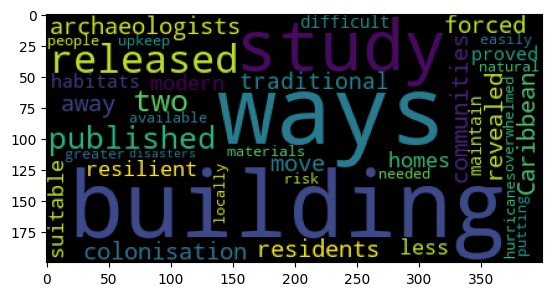
Wordclouds are visual representations of text data. They work by arranging words in a shape so that words with the highest frequency appear in a larger font. They are not particularly useful as an analytical tool, except as a visual device to draw attention to key themes.

Creating wordclouds using Python is relatively simple. Example below.

Code
some_text = '''A study released in 2020, published by two 
archaeologists, revealed how colonisation forced 
residents in Caribbean communities to move away 
from traditional and resilient ways of building 
homes to more modern but less suitable ways. These 
habitats have proved to be more difficult to 
maintain, with the materials needed for upkeep not 
locally available, and the buildings easily 
overwhelmed by hurricanes, putting people at 
greater risk during natural disasters.'''

from wordcloud import WordCloud
plt.imshow(WordCloud().generate_from_text(some_text))


20.4 Topic Modeling

  • Topic modeling, in essence, is a clustering technique to group similar documents together in a single cluster.
  • Topic modeling can be used to find themes across a large corpus of documents as each cluster can be expected to represent a certain theme.
  • The analyst has to specify the number of ‘topics’ (or clusters) to identify.
  • For each cluster that is identified by topic modeling, top words that relate to that cluster can also be reviewed.
  • In practice however, the themes are not always obvious, and trial and error is an extensive part of the topic modeling process.
  • Topic modeling can be extremely helpful in starting to get to grips with a large data set.
  • Topic Modeling is not based on neural networks, but instead on linear algebra relating to matrix decomposition of the document term matrix for the corpus.
  • Creating the document term matrix is the first step for performing topic modeling. There are several decisions for the analyst to consider when building the document term matrix.
    • Whether to use a count based or TF-IDF based vectorization for building the document term matrix,
    • Whether to use words, or n-grams, and if n-grams, then what should n be
  • When performing matrix decomposition, again there are decisions to be made around the mathematical technique to use. The most common ones are:
    • NMF: Non-negative Matrix Factorization
    • LDA: LatentDirichletAllocation

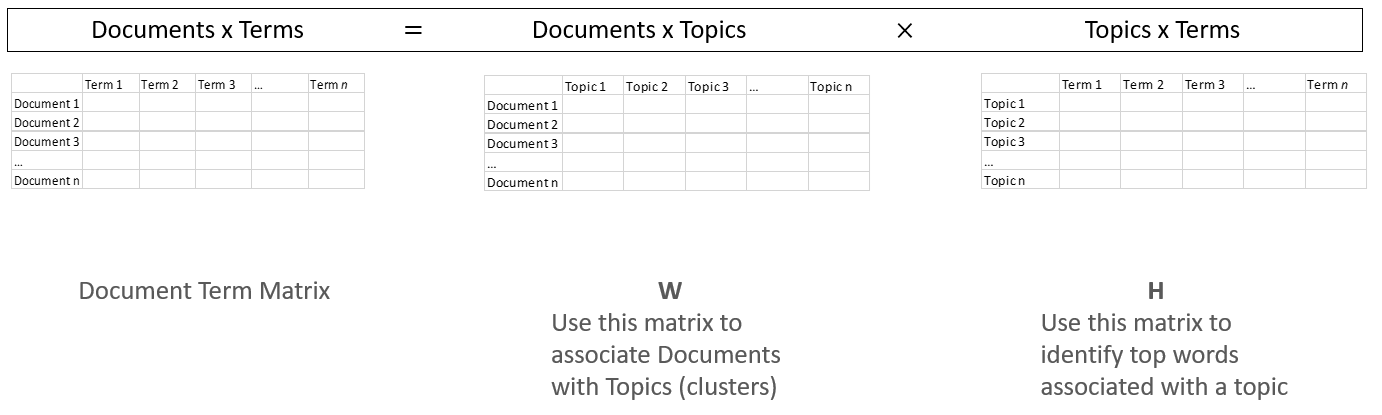
Matrix Factorization Matrix factorization of the document term matrix gives us two matrices, one of which identifies each document in our list as belonging to a particular topic, and the other gives us the top terms in every topic.

image.png

BERTopic — neural topic modeling: The LDA/NMF approach above treats each document as a bag of words and struggles with coherent topic labels. BERTopic (pip install bertopic) uses sentence embeddings + HDBSCAN clustering + a TF-IDF variant to produce topics that are far more semantically coherent with minimal tuning. A single call:

from bertopic import BERTopic
topic_model = BERTopic()
topics, probs = topic_model.fit_transform(raw_documents)
topic_model.get_topic_info()

It handles dynamic topics, hierarchical topic trees, and interactive visualisation out of the box.

Topic Modeling in Action
Steps:
1. Load the text data. Every tweet is a ‘document’, as an entry in a list. 2. Vectorize and create a document term matrix based on count (or TF-IDF). If required, remove stopwords as part of pre-processing options. Specify n for if n-grams are to be used instead of words. 3. Pick the model – NMF or LDA – and apply to the document term matrix from step 2.
- More information on NMF at https://scikit-learn.org/stable/modules/generated/sklearn.decomposition.NMF.html - More information on LDA at https://scikit-learn.org/stable/modules/generated/sklearn.decomposition.LatentDirichletAllocation.html 4. Extract and use the W and H matrices to determine topics and terms.

Load the file ’Corona_NLP_train.csv’ for Corona related tweets, using the column ‘Original Tweet’ as the document corpus. Cluster the tweets into 10 different topics using both NMF and LDA, and examine the results.

Code
# Regular library imports

from sklearn.feature_extraction.text import TfidfVectorizer, CountVectorizer
from sklearn.decomposition import NMF, LatentDirichletAllocation
Code
# Read the data
# Adapted from source: https://www.kaggle.com/datatattle/covid-19-nlp-text-classification

text = pd.read_csv('Corona_NLP_train.csv', encoding='latin1')

text = text.sample(10000) # Let us limit to 10000 random articles for illustration purposes

print('text.shape', text.shape)
text.shape (10000, 6)
Code
# Read stopwords from file

custom_stop_words = []
file = open(file = "stopwords.txt", mode = 'r')
custom_stop_words = file.read().split('\n')
Code
custom_stop_words
['thereof',
 'az',
 'self',
 'ii',
 'apart',
 'again',
 'become',
 'run',
 "why's",
 'indicates',
 'otherwise',
 'couldnt',
 'ys',
 'thus',
 'ej',
 'end',
 'often',
 'say',
 'becomes',
 'consequently',
 'overall',
 'cl',
 'index',
 'took',
 'beforehand',
 'considering',
 'theyre',
 "i'd",
 'looks',
 'fn',
 'over',
 'ra',
 'hereby',
 'similar',
 'dj',
 'lc',
 'los',
 'ip',
 'oj',
 'om',
 'really',
 'out',
 'thin',
 'zi',
 'could',
 'all',
 'bn',
 'brief',
 'sorry',
 'mo',
 'n',
 'nine',
 'stop',
 'ih',
 'asking',
 'n2',
 'four',
 'willing',
 'itd',
 'L',
 'after',
 'pas',
 'http',
 'along',
 'allow',
 'help',
 'ref',
 'knows',
 'R',
 "i'm",
 'name',
 'whereafter',
 'J',
 'ma',
 'H',
 'believe',
 'ge',
 'gave',
 'viz',
 'another',
 'go',
 'at',
 "isn't",
 'vo',
 'novel',
 'wouldnt',
 'than',
 'l',
 'ignored',
 'between',
 'ke',
 'they',
 'wouldn',
 'but',
 'da',
 'ga',
 'lately',
 'similarly',
 'rm',
 'pq',
 'b3',
 'uk',
 'hi',
 'briefly',
 'b1',
 'ct',
 'hasnt',
 'shouldn',
 "there'll",
 'ones',
 'uo',
 'xt',
 'or',
 'using',
 'whether',
 'serious',
 'well-b',
 'looking',
 'con',
 'ay',
 "he's",
 'came',
 'xj',
 "aren't",
 'bu',
 'mightn',
 'pages',
 'e',
 'fify',
 'bk',
 'eo',
 "we'll",
 'ci',
 'little',
 'G',
 'dr',
 'rd',
 'fc',
 'nobody',
 'ml',
 'back',
 'certainly',
 'way',
 'section',
 'bi',
 'ad',
 'six',
 'thereupon',
 'r2',
 'w',
 'theyd',
 'mug',
 'both',
 'awfully',
 'everywhere',
 'liked',
 't1',
 'this',
 'information',
 'ry',
 'taken',
 'too',
 'forth',
 'bd',
 '0o',
 'ec',
 'get',
 'iy',
 'line',
 'first',
 "mustn't",
 'says',
 'yt',
 'getting',
 'thickv',
 'pp',
 'bx',
 'system',
 'if',
 'few',
 'kept',
 'pr',
 'sometime',
 'sq',
 'resulted',
 'past',
 'mg',
 'still',
 'gy',
 'hasn',
 'et',
 'largely',
 'est',
 'page',
 'cz',
 'some',
 'consider',
 '3b',
 'fr',
 'interest',
 'means',
 'being',
 'giving',
 'seen',
 'mustn',
 'sup',
 'tb',
 'il',
 'sz',
 'through',
 'everyone',
 'next',
 'ninety',
 'doesn',
 'dy',
 'namely',
 'as',
 'per',
 'anywhere',
 'specifying',
 'like',
 'nl',
 'ee',
 'probably',
 'ui',
 'K',
 'selves',
 'hence',
 'let',
 't',
 'com',
 'ab',
 'iq',
 'ls',
 'pagecount',
 'pi',
 'invention',
 'yourselves',
 'although',
 'nc',
 'very',
 "needn't",
 'soon',
 'u',
 'whom',
 '3a',
 'dl',
 'accordance',
 'these',
 'followed',
 'Z',
 'ex',
 'indicate',
 'other',
 "we've",
 'need',
 'does',
 'obviously',
 'km',
 'didn',
 'might',
 'off',
 'mrs',
 'fl',
 'que',
 'm2',
 'os',
 'associated',
 'unfortunately',
 'rf',
 'itself',
 "here's",
 'anything',
 'tx',
 'becoming',
 'well',
 "a's",
 "you've",
 'last',
 'something',
 'thousand',
 'ig',
 'available',
 'causes',
 'inward',
 'proud',
 'unless',
 'whim',
 'S',
 'O',
 's2',
 'i2',
 'bp',
 'put',
 'described',
 'heres',
 'a1',
 'ae',
 'would',
 'im',
 'arent',
 'usually',
 'themselves',
 'sa',
 'f',
 "didn't",
 'ds',
 'particularly',
 'ask',
 'either',
 'show',
 'two',
 'P',
 'okay',
 'fo',
 'hundred',
 'used',
 'sp',
 'thereafter',
 'ic',
 'ending',
 'vj',
 'course',
 'them',
 'want',
 "hadn't",
 'x3',
 'i7',
 'eq',
 'abst',
 'og',
 've',
 'former',
 'ph',
 'x1',
 "doesn't",
 "it'll",
 'one',
 'significantly',
 'o',
 'once',
 'downwards',
 'ia',
 'primarily',
 'reasonably',
 'sm',
 'sub',
 'hello',
 'a',
 'xx',
 'nearly',
 'about',
 'bj',
 'cu',
 'eu',
 'seeming',
 'sent',
 '6o',
 'js',
 'now',
 "they'll",
 'related',
 'keeps',
 "what'll",
 "there've",
 'ot',
 'comes',
 "t's",
 'oi',
 's',
 'containing',
 'neither',
 'bill',
 'N',
 'lets',
 'ti',
 'third',
 'shows',
 'won',
 'actually',
 'c',
 'di',
 'youre',
 'nevertheless',
 'while',
 'though',
 'til',
 'strongly',
 'part',
 'ca',
 'af',
 'are',
 'al',
 'ar',
 'ef',
 'himself',
 'non',
 'owing',
 'wed',
 'found',
 "we're",
 'sufficiently',
 "what's",
 'x',
 'hereafter',
 'regardless',
 'twenty',
 'cy',
 'likely',
 'tv',
 'approximately',
 'inc',
 'iz',
 'thence',
 'em',
 'u201d',
 "'ll",
 'on',
 'ax',
 'just',
 'others',
 'ea',
 'secondly',
 'wonder',
 'A',
 'I',
 'de',
 'ix',
 'pn',
 'hopefully',
 'twelve',
 'th',
 'cr',
 'y',
 'slightly',
 'c2',
 'wasn',
 'bottom',
 'tries',
 'mainly',
 'moreover',
 'ko',
 "i'll",
 'corresponding',
 'besides',
 "let's",
 'nd',
 'beside',
 'dk',
 'hardly',
 'shed',
 'hid',
 'somewhat',
 'ten',
 'ni',
 'lest',
 'po',
 'poorly',
 'tm',
 'five',
 'gets',
 "how's",
 'ft',
 'able',
 'na',
 "they've",
 'va',
 'certain',
 'especially',
 'full',
 'least',
 'rn',
 'e3',
 'fill',
 'whole',
 'uses',
 'despite',
 'shall',
 'inner',
 'our',
 'fj',
 'gi',
 'fifteen',
 'll',
 'obtain',
 'seem',
 'lj',
 'same',
 'thank',
 'aren',
 'yes',
 'contains',
 'later',
 'p3',
 'because',
 'eighty',
 'etc',
 'their',
 'ep',
 'sc',
 'werent',
 'anymore',
 'previously',
 'describe',
 'may',
 'begin',
 'biol',
 'ut',
 "she'll",
 'bl',
 'meanwhile',
 'readily',
 'se',
 "who'll",
 'somewhere',
 'the',
 'think',
 'yj',
 'gj',
 'od',
 'ou',
 'specify',
 'various',
 'yours',
 'lr',
 'nt',
 'presumably',
 'saw',
 'elsewhere',
 'whatever',
 'B',
 'V',
 "mightn't",
 'in',
 "it's",
 'ey',
 'me',
 'together',
 'rs',
 'ain',
 'yet',
 'new',
 'ps',
 'towards',
 'successfully',
 'eg',
 'par',
 'py',
 'un',
 'mt',
 'sure',
 'omitted',
 'throughout',
 'also',
 'beyond',
 'affects',
 'sometimes',
 'take',
 'therere',
 'having',
 'present',
 'rc',
 'he',
 'nonetheless',
 'd',
 'have',
 'eleven',
 'your',
 'latterly',
 'en',
 'where',
 'value',
 'lt',
 "that's",
 'anyhow',
 'ch',
 'among',
 'by',
 'thru',
 "couldn't",
 'W',
 'c1',
 'maybe',
 'meantime',
 'it',
 "there's",
 'of',
 'happens',
 'cause',
 'merely',
 'fix',
 'for',
 'had',
 'ourselves',
 'rq',
 'her',
 'what',
 'thanks',
 "'ve",
 'oc',
 'somebody',
 'inasmuch',
 'do',
 'ba',
 'look',
 'instead',
 'possible',
 'wheres',
 'ts',
 'oa',
 'ah',
 'down',
 'wi',
 'el',
 'cm',
 'hr',
 'usefully',
 'yl',
 'please',
 'an',
 'kg',
 'must',
 'until',
 "wouldn't",
 'F',
 'gs',
 'to',
 'p1',
 'keep',
 'qu',
 'tp',
 'wish',
 'currently',
 "haven't",
 'without',
 'affected',
 'a2',
 'cp',
 'we',
 'normally',
 "who's",
 'obtained',
 'fire',
 'sn',
 "can't",
 'detail',
 'pe',
 'sf',
 'allows',
 "he'll",
 'side',
 'ur',
 'q',
 'cd',
 'si',
 'gotten',
 'es',
 'ne',
 'quite',
 'regards',
 'million',
 'cs',
 'anyway',
 'onto',
 'results',
 'near',
 'plus',
 'tr',
 'seven',
 'yr',
 'so',
 'hj',
 'ib',
 'world',
 'tip',
 'immediately',
 'gl',
 'words',
 'xn',
 'unlike',
 'cit',
 'hu',
 'ups',
 'vt',
 'someone',
 'toward',
 'whoever',
 "we'd",
 'rj',
 'importance',
 'anyways',
 'provides',
 'b',
 'possibly',
 'any',
 'which',
 'beginning',
 'tell',
 'important',
 'during',
 'entirely',
 'noone',
 'whats',
 'miss',
 'du',
 'ms',
 'av',
 'across',
 'thanx',
 'www',
 'can',
 'appropriate',
 'pc',
 'his',
 'youd',
 'due',
 'tj',
 'ao',
 'every',
 'within',
 "you'd",
 'below',
 'lb',
 'tf',
 'know',
 'theirs',
 'there',
 'mu',
 'ng',
 'co',
 'i',
 "that'll",
 'no',
 'then',
 'vq',
 'best',
 'nn',
 'ei',
 'act',
 'further',
 'example',
 'afterwards',
 'done',
 'weren',
 "c's",
 'resulting',
 'mine',
 'many',
 'a4',
 'ri',
 'sj',
 "you're",
 'ie',
 'went',
 'given',
 'mostly',
 'pm',
 'see',
 'outside',
 'date',
 'got',
 'makes',
 'pl',
 'since',
 'tc',
 "that've",
 'thered',
 'was',
 'seemed',
 'under',
 'xv',
 'effect',
 'hadn',
 'br',
 'qj',
 'saying',
 'dp',
 'rather',
 'recently',
 'shan',
 'unto',
 '0s',
 'old',
 'make',
 'c3',
 'will',
 'thou',
 'different',
 'ss',
 'ok',
 'ny',
 't3',
 "they're",
 'exactly',
 'm',
 'haven',
 'greetings',
 'hy',
 "it'd",
 'st',
 'whence',
 'nothing',
 'you',
 'sensible',
 'seriously',
 'zero',
 'td',
 "won't",
 'rr',
 'sec',
 'appreciate',
 "hasn't",
 'shown',
 'throug',
 'vu',
 'thoughh',
 'relatively',
 'jt',
 'not',
 'xf',
 'tn',
 'E',
 'p',
 'rt',
 'definitely',
 'hers',
 'whereupon',
 'X',
 'fi',
 'dx',
 'couldn',
 'shes',
 'pu',
 'refs',
 'amongst',
 'les',
 'wo',
 'up',
 'wherever',
 'jr',
 'ac',
 'cv',
 'even',
 'contain',
 'respectively',
 'nowhere',
 'fs',
 'whereby',
 'almost',
 'furthermore',
 'arise',
 'only',
 'going',
 'everybody',
 'adj',
 'needs',
 'isn',
 'showns',
 'anyone',
 'and',
 'a3',
 'indicated',
 'however',
 'gives',
 'ibid',
 'were',
 'top',
 'whither',
 'twice',
 'la',
 'concerning',
 'ho',
 'T',
 'therefore',
 'insofar',
 'v',
 'cx',
 'anybody',
 'following',
 'follows',
 'z',
 'here',
 'ln',
 'ru',
 'jj',
 'beginnings',
 'vs',
 'wa',
 'doing',
 'that',
 'with',
 'except',
 'tt',
 'h2',
 'home',
 'far',
 'dd',
 'should',
 'vols',
 'when',
 'l2',
 'research',
 'whose',
 'sd',
 'perhaps',
 'welcome',
 'hereupon',
 'zz',
 'ap',
 'whod',
 'bt',
 'thereto',
 'cj',
 'lf',
 'wont',
 'else',
 'more',
 'appear',
 'nj',
 'upon',
 'whenever',
 'always',
 'empty',
 'xk',
 'M',
 'nay',
 '6b',
 "shouldn't",
 'io',
 'ob',
 'predominantly',
 'oo',
 'promptly',
 'second',
 'showed',
 'hh',
 'myself',
 'ow',
 'made',
 'enough',
 'been',
 'pk',
 'aw',
 "where's",
 'much',
 'b2',
 'cc',
 'ran',
 'has',
 'cannot',
 "don't",
 'cf',
 'hed',
 'immediate',
 'ed',
 'noted',
 'whos',
 'announce',
 'f2',
 'dc',
 'hither',
 'df',
 'each',
 'specified',
 'k',
 'needn',
 'those',
 'U',
 'bc',
 'unlikely',
 'sy',
 'tried',
 'ol',
 'ord',
 'thats',
 "when's",
 'au',
 'sr',
 'nor',
 'such',
 'h',
 'give',
 'don',
 'taking',
 'cg',
 'wants',
 'find',
 'before',
 'dt',
 'recent',
 'amount',
 'substantially',
 'theres',
 'ltd',
 'several',
 "she'd",
 'pf',
 'somehow',
 'pt',
 'um',
 ...]

Next, we do topic modeling on the tweets. The next few cells have the code to do this.

It is a lot of code, but let us just take a step back from the code to think about what it does.

We need to provide it three inputs: - the text,
- the number of topics we want identified, and
- the value of n for our ngrams.

Once done, the code below will create two dataframes:

  • words_in_topics_df - top_n_words per topic
  • topic_for_doc_df - topic to which a document is identified

Additional outputs of interest
- vocab = This is the dict from which you can pull the words, eg vocab[‘ocean’]
- terms = Just the list equivalent of vocab, indexed in the same order
- term_frequency_table = dataframe with the frequency of terms
- doc_term_matrix = Document term matrix (doc_term_matrix = W x H)
- W = This matrix has docs as rows and num_topics as columns
- H = This matrix has num_topics as rows and vocab as columns

Code
# Specify inputs
# Input incoming text as a list called raw_documents

raw_documents= list(text['OriginalTweet'].values.astype('U'))
max_features = 5000 # vocab size
num_topics = 10
ngram = 2 # 2 for bigrams, 3 for trigrams etc
Code
len(raw_documents)
10000
Code
raw_documents[3350]
'Nevada To report scams or consumer fraud related to COVID 19 like  coordinated increases in prices for goods or services you can file a complaint with s office at or call 2 hot lines 702 486 3132 or 888 434 9989'
Code
# use count based vectorizer from sklearn

# vectorizer = CountVectorizer(stop_words = custom_stop_words, min_df = 2, analyzer='word', ngram_range=(ngram, ngram))

# or use TF-IDF based vectorizer
vectorizer = TfidfVectorizer(max_df=0.95, min_df=2, max_features= max_features, stop_words=custom_stop_words, analyzer='word', ngram_range=(ngram, ngram))

# Create document term matrix
doc_term_matrix = vectorizer.fit_transform(raw_documents)
print( "Created %d X %d document-term matrix in variable doc_term_matrix\n" % (doc_term_matrix.shape[0], doc_term_matrix.shape[1]) )


vocab = vectorizer.vocabulary_ #This is the dict from which you can pull the words, eg vocab['ocean']
terms = vectorizer.get_feature_names_out() #Just the list equivalent of vocab, indexed in the same order
print("Vocabulary has %d distinct terms, examples below " % len(terms))
print(terms[500:550], '\n')

term_frequency_table = pd.DataFrame({'term': terms,'freq': list(np.array(doc_term_matrix.sum(axis=0)).reshape(-1))})
term_frequency_table = term_frequency_table.sort_values(by='freq', ascending=False).reset_index()

freq_df = pd.DataFrame(doc_term_matrix.todense(), columns = terms)
freq_df = freq_df.sum(axis=0)
freq_df = freq_df.sort_values(ascending=False)
Created 10000 X 5000 document-term matrix in variable doc_term_matrix

Vocabulary has 5000 distinct terms, examples below 
['close store' 'close stores' 'close weeks' 'closed covid'
 'closed government' 'closed retail' 'closely suppliers' 'closes stores'
 'closing retail' 'closing stores' 'closings destroy' 'closures https'
 'coffee shops' 'coles woolworths' 'collapse oil' 'combat coronavirus'
 'combat covid' 'combat spread' 'combating covid' 'combined 100'
 'comedy hotchick' 'coming contact' 'coming days' 'coming months'
 'coming weeks' 'commerce platform' 'commerce prices' 'commerce sales'
 'commission prices' 'commodities coronavirus' 'commodities including'
 'commodity prices' 'common household' 'common sense' 'communities covid'
 'community amp' 'community covid' 'community food' 'community https'
 'community quarantine' 'community spirit' 'community spread'
 'companies coronavirus' 'companies https' 'companies offering'
 'companies produce' 'companies raise' 'companies set' 'company https'
 'company work'] 
Code
# create the model
# Pick between NMF or LDA methods (don't know what they are, try whichever gives better results)

# Use NMF
# model = NMF( init="nndsvd", n_components=num_topics ) 

# Use LDA
model = LatentDirichletAllocation(n_components=num_topics, learning_method='online') 
    
# apply the model and extract the two factor matrices
W = model.fit_transform( doc_term_matrix ) #This matrix has docs as rows and k-topics as columns
H = model.components_ #This matrix has k-topics as rows and vocab as columns
print('Shape of W is', W.shape, 'docs as rows and', num_topics, 'topics as columns. First row below')
print(W[0].round(1))
print('\nShape of H is', H.shape, num_topics, 'topics as rows and vocab as columns. First row below')
print(H[0].round(1))
Shape of W is (10000, 10) docs as rows and 10 topics as columns. First row below
[0.  0.  0.  0.  0.6 0.  0.  0.  0.  0. ]

Shape of H is (10, 5000) 10 topics as rows and vocab as columns. First row below
[0.1 0.1 0.1 ... 0.1 0.1 0.1]
Code
# Check which document belongs to which topic, and print value_count
topic_for_doc_df = pd.DataFrame(columns = ['article', 'topic', 'value'])
for i in range(W.shape[0]):
    a = W[i] 
    b = np.argsort(a)[::-1]
    temp_df = pd.DataFrame({'article': [i], 'topic':['Topic_'+str(b[0])], 'value': [a[b[0]]]})
    topic_for_doc_df = pd.concat([topic_for_doc_df, temp_df])

top_docs_for_topic_df = pd.DataFrame(columns = ['topic', 'doc_number', 'weight'])    
for i in range(W.shape[1]):
    topic = i
    temp_df = pd.DataFrame({'topic': ['Topic_'+str(i) for x in range(W.shape[0])], 
                            'doc_number':  list(range(W.shape[0])), 
                            'weight': list(W[:,i])})
    temp_df = temp_df.sort_values(by=['topic', 'weight'], ascending=[True, False])
    top_docs_for_topic_df = pd.concat([top_docs_for_topic_df, temp_df])
# Add text to the top_docs dataframe as a new column
top_docs_for_topic_df['text']=[raw_documents[i] for i in list(top_docs_for_topic_df.doc_number)] 
C:\Users\user\AppData\Local\Temp\ipykernel_23804\3025426810.py:7: FutureWarning: The behavior of DataFrame concatenation with empty or all-NA entries is deprecated. In a future version, this will no longer exclude empty or all-NA columns when determining the result dtypes. To retain the old behavior, exclude the relevant entries before the concat operation.
  topic_for_doc_df = pd.concat([topic_for_doc_df, temp_df])
C:\Users\user\AppData\Local\Temp\ipykernel_23804\3025426810.py:16: FutureWarning: The behavior of DataFrame concatenation with empty or all-NA entries is deprecated. In a future version, this will no longer exclude empty or all-NA columns when determining the result dtypes. To retain the old behavior, exclude the relevant entries before the concat operation.
  top_docs_for_topic_df = pd.concat([top_docs_for_topic_df, temp_df])
Code
# Print top two docs for each topic
print('\nTop documents for each topic')
(top_docs_for_topic_df.groupby('topic').head(2))

Top documents for each topic
topic doc_number weight text
1610 Topic_0 1610 0.798085 @alessi0p We're working closely with suppliers...
2795 Topic_0 2795 0.798085 @wearyrabbit Hi there - We're working closely ...
3038 Topic_1 3038 0.764399 Lockdowns and panic food buying due to the #Co...
434 Topic_1 434 0.761876 A senior economist from the United Nation's (U...
2960 Topic_2 2960 0.783764 Concerned about she tweeted on March 10 Re...
6334 Topic_2 6334 0.783764 Concerned about Remember this The consumer is ...
353 Topic_3 353 0.791006 #CoronaCrisis #stopstockpiling #StopPanicBuyin...
662 Topic_3 662 0.790957 #panicbuyinguk #CoronaCrisis #stopstockpiling ...
3137 Topic_4 3137 0.758527 @PusaterisFoods Absolutely disgusted how you c...
7775 Topic_4 7775 0.757125 Make sure to wash your hands often &amp; corre...
2026 Topic_5 2026 0.832419 Kroger, the country's largest supermarket chai...
6242 Topic_5 6242 0.832419 Kroger, the country's largest supermarket chai...
669 Topic_6 669 0.838590 @babsy1234 Hi there! Starting on March 19th, t...
824 Topic_6 824 0.838590 @LoriNichol2 Hi Lori! Starting on March 19th, ...
1077 Topic_7 1077 0.796962 @ssupnow 1.Sanitizer\r\r\n2.Italy \r\r\n3.Wuha...
1083 Topic_7 1083 0.796962 @ssupnow 1.Sanitizer\r\r\n2.Italy \r\r\n3.Wuha...
1015 Topic_8 1015 0.783475 ? @eBay and @amazon are failing to crackdown o...
1818 Topic_8 1818 0.764426 Vulnerable people isolating from Covid-19 cann...
5756 Topic_9 5756 0.764450 Pro-Trump New Jersey man who ‘coughed on supe...
6836 Topic_9 6836 0.752964 New Jersey man who coughed on supermarket wor...
Code
print('Topic number and counts of documents against each:')
(topic_for_doc_df.topic.value_counts())
Topic number and counts of documents against each:
topic
Topic_9    1778
Topic_1    1202
Topic_4    1161
Topic_3    1008
Topic_8     864
Topic_0     826
Topic_5     808
Topic_2     795
Topic_7     785
Topic_6     773
Name: count, dtype: int64
Code
# Create dataframe with top-10 words for each topic
top_n_words = 10

words_in_topics_df = pd.DataFrame(columns = ['topic', 'words', 'freq'])
for i in range(H.shape[0]):
    a = H[i] 
    b = np.argsort(a)[::-1]
    np.array(b[:top_n_words])
    words = [terms[i] for i in b[:top_n_words]]
    freq = [a[i] for i in b[:top_n_words]]
    temp_df = pd.DataFrame({'topic':'Topic_'+str(i), 'words': words, 'freq': freq})
    words_in_topics_df = pd.concat([words_in_topics_df, temp_df])

print('\n')
print('Top', top_n_words, 'words dataframe with weights')
(words_in_topics_df.head(10))


Top 10 words dataframe with weights
C:\Users\user\AppData\Local\Temp\ipykernel_23804\4023544607.py:12: FutureWarning: The behavior of DataFrame concatenation with empty or all-NA entries is deprecated. In a future version, this will no longer exclude empty or all-NA columns when determining the result dtypes. To retain the old behavior, exclude the relevant entries before the concat operation.
  words_in_topics_df = pd.concat([words_in_topics_df, temp_df])
topic words freq
0 Topic_0 supermarket shelves 54.715233
1 Topic_0 stock food 31.922033
2 Topic_0 retail store 23.295509
3 Topic_0 covid2019 https 21.792888
4 Topic_0 supermarket https 16.621298
5 Topic_0 work grocery 15.070641
6 Topic_0 panic buying 14.336548
7 Topic_0 grocery store 14.250838
8 Topic_0 store closures 13.527987
9 Topic_0 coronavirus covid2019 13.359654
Code
# print as list
print('\nSame list as above as a list')
words_in_topics_list = words_in_topics_df.groupby('topic')['words'].apply(list)
lala =[]
for i in range(len(words_in_topics_list)):
    a = [list(words_in_topics_list.index)[i]]
    b = words_in_topics_list[i]
    lala = lala + [a+b]
    print(a + b) 


Same list as above as a list
['Topic_0', 'supermarket shelves', 'stock food', 'retail store', 'covid2019 https', 'supermarket https', 'work grocery', 'panic buying', 'grocery store', 'store closures', 'coronavirus covid2019']
['Topic_1', 'coronavirus covid19', 'panic buying', 'covid pandemic', 'covid19 https', 'coronavirus pandemic', 'coronavirus covid', 'covid_19 https', 'covid coronavirus', 'pandemic https', 'covid crisis']
['Topic_2', 'coronavirus toiletpaper', 'covid outbreak', 'amid covid', 'toiletpaper https', 'hand sanitizers', 'outbreak https', 'online https', 'online shopping', 'increased demand', 'long term']
['Topic_3', 'toilet paper', 'oil prices', 'coronavirus outbreak', 'supply chain', 'coronavirus covid_19', 'local supermarket', 'toiletpaper coronavirus', 'food supply', 'covid_19 coronavirus', 'coronavirus https']
['Topic_4', 'coronavirus https', 'hand sanitizer', 'covid19 coronavirus', 'grocery store', 'store workers', 'social distancing', 'price gouging', 'grocery stores', 'wash hands', 'health care']
['Topic_5', 'covid https', 'consumer behavior', 'prices coronavirus', 'prices covid', 'spread covid', 'face masks', 'hiking prices', 'fight covid', 'covid virus', 'face mask']
['Topic_6', 'shopping online', 'supermarket workers', 'people panic', 'supply chains', 'inflated prices', 'global pandemic', 'corona virus', 'consumer sentiment', 'food amp', 'oil prices']
['Topic_7', 'stay safe', 'grocery shopping', 'food bank', 'panic buy', 'online grocery', 'demand https', 'raise prices', 'high prices', 'food banks', 'food delivery']
['Topic_8', 'online shopping', 'gas prices', 'coronavirus crisis', 'social distancing', 'shopping https', 'covid pandemic', 'covid lockdown', 'shelves stocked', 'shopping coronavirus', 'vulnerable coronavirus']
['Topic_9', 'grocery store', 'local grocery', 'store employees', 'consumer spending', 'supermarket staff', 'coronavirus https', 'consumer behaviour', 'stock market', 'store coronavirus', 'today https']
C:\Users\user\AppData\Local\Temp\ipykernel_23804\1593796434.py:7: FutureWarning: Series.__getitem__ treating keys as positions is deprecated. In a future version, integer keys will always be treated as labels (consistent with DataFrame behavior). To access a value by position, use `ser.iloc[pos]`
  b = words_in_topics_list[i]
Code
# Top terms
print('\nTop 10 most numerous terms:')
term_frequency_table.head(10)

Top 10 most numerous terms:
index term freq
0 1959 grocery store 353.660819
1 759 coronavirus https 172.838823
2 1985 hand sanitizer 141.660019
3 2678 online shopping 130.792649
4 722 coronavirus covid19 120.250304
5 4584 toilet paper 113.301746
6 1075 covid19 coronavirus 105.948951
7 2771 panic buying 98.477036
8 1014 covid pandemic 83.931306
9 2642 oil prices 81.965440

20.5 Applying ML and AI Algorithms to Text Data

We will use movie reviews as an example to build a model to predict whether the review is positive or negative. The data already has human assigned labels, so we can try to see if our models can get close to human level performance.

20.5.1 Movie Review Classification with XGBoost

Let us get some text data to play with. We will use the IMDB movie review dataset which has 50,000 movie reviews, classified as positive or negative.

We load the data, and look at some random entries.

There are 25k positive, and 25k negative reviews.

Better features with sentence-transformers: The TF-IDF → XGBoost pipeline below is a strong, interpretable baseline. For higher accuracy, replace the TF-IDF feature step with dense sentence embeddings:

from sentence_transformers import SentenceTransformer
model = SentenceTransformer('all-MiniLM-L6-v2')  # 80 MB, runs on CPU
X_train_emb = model.encode(X_train.tolist())
X_test_emb  = model.encode(X_test.tolist())
# Then fit any classifier on X_train_emb / X_test_emb

Sentence embeddings typically boost accuracy by 5–15 percentage points on sentiment/classification tasks vs TF-IDF, with no vocabulary engineering required.

Code
# Library imports

import numpy as np
import matplotlib.pyplot as plt
import pandas as pd
import statsmodels.api as sm
import seaborn as sns
from tensorflow.keras.preprocessing.text import Tokenizer
Code
# Read the data, create the X and y variables, and look at the dataframe

df = pd.read_csv("IMDB_Dataset.csv")
X = df.review
y = df.sentiment
df
review sentiment
0 One of the other reviewers has mentioned that ... positive
1 A wonderful little production. <br /><br />The... positive
2 I thought this was a wonderful way to spend ti... positive
3 Basically there's a family where a little boy ... negative
4 Petter Mattei's "Love in the Time of Money" is... positive
... ... ...
49995 I thought this movie did a down right good job... positive
49996 Bad plot, bad dialogue, bad acting, idiotic di... negative
49997 I am a Catholic taught in parochial elementary... negative
49998 I'm going to have to disagree with the previou... negative
49999 No one expects the Star Trek movies to be high... negative

50000 rows × 2 columns

Code
# let us look at two random reviews

x = np.random.randint(0, len(df))
print(df['sentiment'][x:x+2])
list(df['review'][x:x+2])
36380    positive
36381    positive
Name: sentiment, dtype: object
['The entire movie, an artful adaptation of one of Joyce\'s "Dubliners" stories, takes place on the night of January 6 (Epiphany), 1906. Most of the film takes place at an annual party given by three spinsters (two sisters and their niece), where a group of upper-class Dubliners gather for an evening of music, recitations and dinner. While there is very little plot per se, the interaction and conversation among the group reveals much about Dublin in the early 20th century when the stirrings for independence were just beginning. The cast, all talented Irish stage actors with the exception of Anjelica Huston, are universally wonderful, and one actually feels he is a guest at the gathering himself. The poignant final scene, between Ms. Huston and the amazing Donal McCann, reveals much about the marriage of the characters. There is poignancy mixed with humor and insight, and for those who like quiet, thoughtful movies, "The Dead" is highly recommended. My wife is from Dublin, we make a ritual of watching this wonderful movie every January 6th. After many viewings it never fails to move me, and each time I glean something that I\'ve missed before.',
 'Renee Zellweger is a Kansas housewife whose domineering husband is mixed up in drug trafficking. Two professional hit men -- Morgan Freeman and his son, Chris Rock, murder the husband in his dining room. Zellweger, unobserved by the killers, witnesses this and undergoes a dissociative reaction, assuming the personality of a nurse -- the eponymous Betty -- who is a character in her favorite soap opera. Believing herself to be the TV character, Zellweger takes off in her husband\'s car, which has a load of dope in the trunk, and travels to LA where she hopes to link up with another character in this mindless afternoon drama, "Dr. David Ravell", Greg Kinnear. Not realizing she is being pursued by the two hit men, she drives to LA where she manages to link up with Kinnear and is actually written into the show as a nurse named Betty. A handful of men in the know, including the local sheriff, catch on to what\'s happening and also seek Zellweger in LA. The ending is believable and poignant.<br /><br />If that sounds crazy, it\'s because it is. And it\'s the writer\'s responsibility, John C. Richards. The curious thing is that Richards and the director, Neil Labute, with considerable help from the performers, just about pull it all off. This isn\'t a plot that has been cast in a familiar mold. Nope. I give it bonus points for sheer originality. Somebody went out on a limb. Somebody took a chance on a movie that was NOT a copy or remake of something that had made money ten years or fifty years ago. I imagine the people involved, down on their knees every night, praying fervently. I don\'t know if the film was remunerative but it\'s mostly successful on its own aesthetic terms.<br /><br />It\'s what might be called an "initial premise" movie. You start off with a single transformative event, in this case the murder of Zellweger\'s husband and her adoption of a genuinely new personality, and follow the resultant logical paths realistically. "Groundhog Day" is another, better and more intricately plotted, example. "Nurse Betty" has its logical cracks, where the incidents give up their plausibility. Eg., at a party in LA, Zellweger finally runs into Kinnear, the guy who plays her ex-fiancé on TV. She\'s stunned (because, after all, she thinks she\'s Betty, who lost her fiancé long ago). She approaches Kinnear and a couple of his colleagues and introduces herself as "Nurse Betty", the character. She addresses Kinnear by the name of his TV character, "David Ravell." The group are puzzled at first, then convince themselves that she\'s an aspiring actress who insists on staying "in character" during the conversation -- and afterward, too, after Kinnear has become fascinated by her and the others bored. Kinnear drives her home and even when she kisses him goodnight, she\'s still in character, leaving Kinnear wide-eyed with astonishment at the relentless way she captures the character of Betty. On the next date, Kinnear returns her love. That development, the relationship between Zellweger and Kinnear at this point, is a crack in the logic, the kind that\'s absent from "Groundhog Day." By the end of Night One, Kinnear, like any other person, would realize that Zellweger is a few clowns short of a circus.<br /><br />The rest of the film, which includes many digressions, succeeds beyond expectations. The relationship between Morgan Freeman and his insolent, nihilistic son is marvelously spelled out. Morgan is flawless in his exasperation. He manages to fall in love with the image of Zellweger as he unearths clues to her whereabouts and activities, and at the end he can\'t bring himself to shoot her. She\'s too sweet to shoot. After her transformation into Betty, she left a note behind in Kansas. "I want to help all life, whether it be animal, plant, or mineral." Who could harm the author of such a preposterous connative statement? His admiration of her comes as an epiphany, as he stands near one of the floodlights at the rim of the Grand Canyon. Zellweger, dressed as Dorothy, or maybe the Good Witch of the East -- well, characters that, like Zellweger, are from Kansas anyway -- appears to Freeman and he embraces her and kisses her tenderly. It\'s a scene that\'s at once eerie, romantic, and a little spooky. I once stood at one of those lights and threw some shredded paper into the updraft from the dark canyon and found myself surrounded by a thousand swirling bats who had misperceived the fluttering shreds as moths.<br /><br />Right. Where was I? Okay. I was trying not to run out of space. Zellweger\'s performance deserves plaudits. Everything she does, every movement, every utterance, is naive and tentative. She really IS a likable character -- and that despite the fact that she\'s no glamor girl by Hollywood standards. But -- what an actress. Compare her performance as the bumptious 19th-century hick in "Cold Mountain." Just the opposite. But then everyone is up to snuff in this enjoyable film. Allyson Jannings does a fine job in a minor role. Watch her when she tells Greg Kinnear that she\'s considering killing off his character in the soap opera in a drowning accident. Kinnear is one of those narcissists who wears the kind of ten-thousand dollar thin black leather jackets that were popular at the time. He chuckles and says, "Oh, one of those castaway deals, right? Okay, how do I get back?" Jannings doesn\'t answer. She just smiles at him with those enormous blue eyes and tilts her head mockingly.<br /><br />Not a masterpiece of film-making but a good, original, professional job by everyone concerned.']
Code
X
0        One of the other reviewers has mentioned that ...
1        A wonderful little production. <br /><br />The...
2        I thought this was a wonderful way to spend ti...
3        Basically there's a family where a little boy ...
4        Petter Mattei's "Love in the Time of Money" is...
                               ...                        
49995    I thought this movie did a down right good job...
49996    Bad plot, bad dialogue, bad acting, idiotic di...
49997    I am a Catholic taught in parochial elementary...
49998    I'm going to have to disagree with the previou...
49999    No one expects the Star Trek movies to be high...
Name: review, Length: 50000, dtype: object
Code
# We do the train-test split

from sklearn.model_selection import train_test_split
X_train, X_test, y_train, y_test = train_test_split(X, y, test_size = 0.20)
print(type(X_train))
print(type(y_train))
<class 'pandas.core.series.Series'>
Code
X_train
28363    It's too bad these guys, the so-called judges,...
23683    This Showtime movie really deserves a far bett...
49804    ***May Contain Spoilers*** OK, it wasn't exact...
4474     Anyone who will pay to see Troma movies knows,...
10099    You would probably get something like this. I'...
                               ...                        
47400    No one goes to a movie like The Hills Have Eye...
6357     I have to admit that this "re-imagining" of th...
22583    This is a fantastic film. The acting is some o...
48359    You know the old saw about a train wreck? The ...
34584    Mike Judge's Idiocracy is an interesting film,...
Name: review, Length: 40000, dtype: object

Approach
Extract a vocabulary from the training text, and give each word a number index.

Take the top 2000 words from this vocab, and convert all tweets into a numerical vector by putting a “1” in the position for a word if that word appears in the tweet. Words not in the vocab get mapped to [UNK]=1.

Construct a Document Term Matrix (which can be binary, or counts, or TFIDF). This is the array we use for X.

Code
# We tokenize the text based on the training data

from tensorflow.keras.preprocessing.text import Tokenizer
tokenizer = Tokenizer(oov_token='[UNK]', num_words=2000)

tokenizer.fit_on_texts(X_train)   
Code
# let us look around the tokenized data


# Word frequency from the dictionary (tokenizer.word_counts())
print('Top words\n', pd.DataFrame(dict(tokenizer.word_counts).items()).sort_values(by=1, ascending=False).head(20).reset_index(drop=True))


# How many documents in the corpus
print('\nHow many documents in the corpus?', tokenizer.document_count)

      
print('Total unique words', len(tokenizer.word_index))
Top words
         0       1
0     the  533783
1     and  260556
2       a  258441
3      of  231887
4      to  215212
5      is  169620
6      br  161722
7      in  149830
8      it  125564
9       i  124128
10   this  120884
11   that  109962
12    was   76558
13     as   73657
14    for   70175
15   with   70113
16  movie   69713
17    but   66874
18   film   62502
19     on   54445

How many documents in the corpus? 40000
Total unique words 112513
Code
# We can also look at the word_index
# But it is very long, and we will not 
# print(tokenizer.word_index)

# Let us print the first 20
list(tokenizer.word_index.items())[:20]
[('[UNK]', 1),
 ('the', 2),
 ('and', 3),
 ('a', 4),
 ('of', 5),
 ('to', 6),
 ('is', 7),
 ('br', 8),
 ('in', 9),
 ('it', 10),
 ('i', 11),
 ('this', 12),
 ('that', 13),
 ('was', 14),
 ('as', 15),
 ('for', 16),
 ('with', 17),
 ('movie', 18),
 ('but', 19),
 ('film', 20)]
Code
# Next, we convert the tokens to a document term matrix
X_train = tokenizer.texts_to_matrix(X_train, mode='binary')
X_test = tokenizer.texts_to_matrix(X_test, mode='binary')
Code
print('X_train.shape', X_train.shape)
X_train[198:202]
X_train.shape (40000, 2000)
array([[0., 1., 1., ..., 0., 0., 0.],
       [0., 1., 1., ..., 0., 0., 0.],
       [0., 1., 1., ..., 0., 0., 0.],
       [0., 1., 1., ..., 0., 0., 0.]])
Code
print('y_train.shape', y_train.shape)
y_train[198:202]
y_train.shape (40000,)
31123    positive
36156    negative
6229     negative
47574    positive
Name: sentiment, dtype: object
Code
y_train
28363    negative
23683    positive
49804    positive
4474     negative
10099    negative
           ...   
47400    negative
6357     negative
22583    positive
48359    negative
34584    positive
Name: sentiment, Length: 40000, dtype: object
Code
# let us encode the labels
from sklearn.preprocessing import LabelEncoder
le = LabelEncoder()

y_train = le.fit_transform(y_train.values.ravel()) # This needs a 1D array
y_test = le.fit_transform(y_test.values.ravel()) # This needs a 1D array
Code
y_train
array([0, 1, 1, ..., 1, 0, 1])
Code
# Enumerate Encoded Classes
dict(list(enumerate(le.classes_)))
{0: 'negative', 1: 'positive'}
Code
# Fit the model
from xgboost import XGBClassifier

model_xgb = XGBClassifier(objective= 'binary:logistic')
model_xgb.fit(X_train, y_train)
XGBClassifier(base_score=None, booster=None, callbacks=None,
              colsample_bylevel=None, colsample_bynode=None,
              colsample_bytree=None, device=None, early_stopping_rounds=None,
              enable_categorical=False, eval_metric=None, feature_types=None,
              gamma=None, grow_policy=None, importance_type=None,
              interaction_constraints=None, learning_rate=None, max_bin=None,
              max_cat_threshold=None, max_cat_to_onehot=None,
              max_delta_step=None, max_depth=None, max_leaves=None,
              min_child_weight=None, missing=nan, monotone_constraints=None,
              multi_strategy=None, n_estimators=None, n_jobs=None,
              num_parallel_tree=None, random_state=None, ...)
In a Jupyter environment, please rerun this cell to show the HTML representation or trust the notebook.
On GitHub, the HTML representation is unable to render, please try loading this page with nbviewer.org.

20.5.1.1 Checking accuracy on the training set

Code
# Perform predictions, and store the results in a variable called 'pred'
pred = model_xgb.predict(X_train)
Code
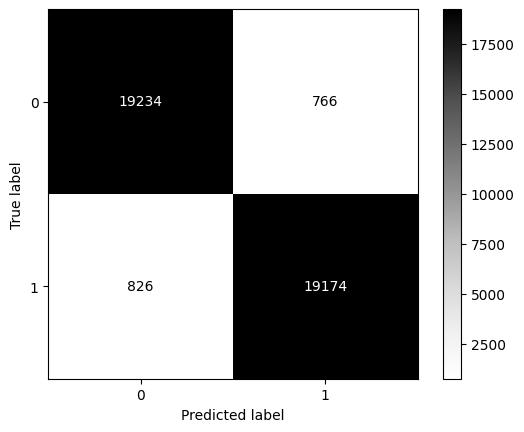
from sklearn.metrics import confusion_matrix, accuracy_score, classification_report, ConfusionMatrixDisplay
# Check the classification report and the confusion matrix
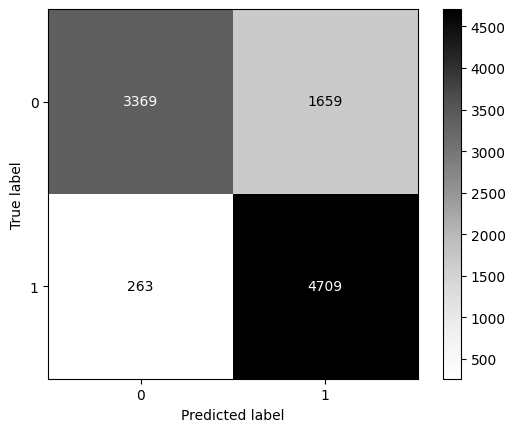
print(classification_report(y_true = y_train, y_pred = pred))
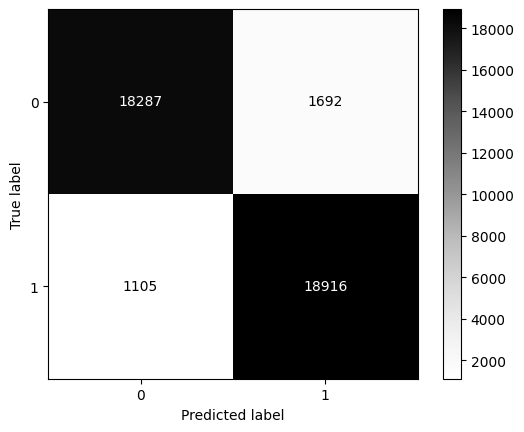
ConfusionMatrixDisplay.from_estimator(model_xgb, X = X_train, y = y_train, cmap='Greys');
              precision    recall  f1-score   support

           0       0.94      0.92      0.93     19979
           1       0.92      0.94      0.93     20021

    accuracy                           0.93     40000
   macro avg       0.93      0.93      0.93     40000
weighted avg       0.93      0.93      0.93     40000

Code
# We can get probability estimates for class membership using XGBoost
model_xgb.predict_proba(X_test).round(3)
array([[0.18 , 0.82 ],
       [0.988, 0.012],
       [0.046, 0.954],
       ...,
       [0.195, 0.805],
       [0.035, 0.965],
       [0.999, 0.001]], dtype=float32)

20.5.1.2 Checking accuracy on the test set

Code
# Perform predictions, and store the results in a variable called 'pred'
pred = model_xgb.predict(X_test)
Code
from sklearn.metrics import confusion_matrix, accuracy_score, classification_report, ConfusionMatrixDisplay
# Check the classification report and the confusion matrix
print(classification_report(y_true = y_test, y_pred = pred))
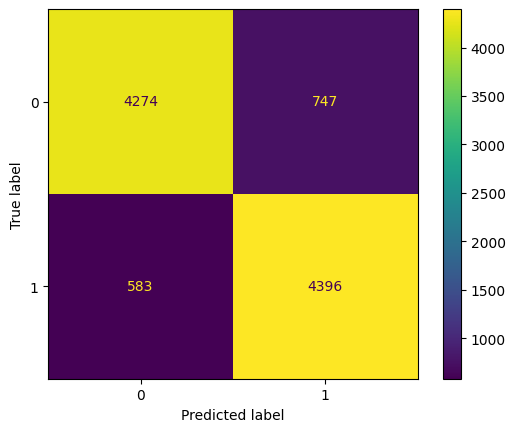
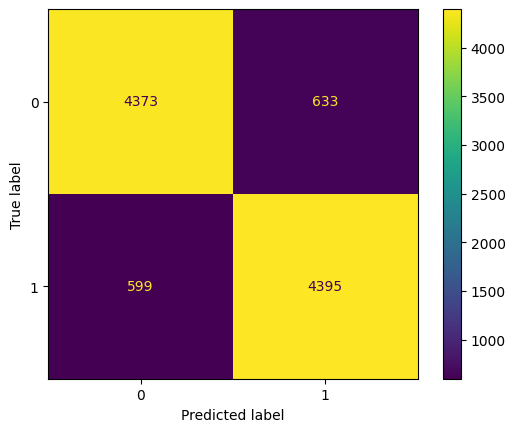
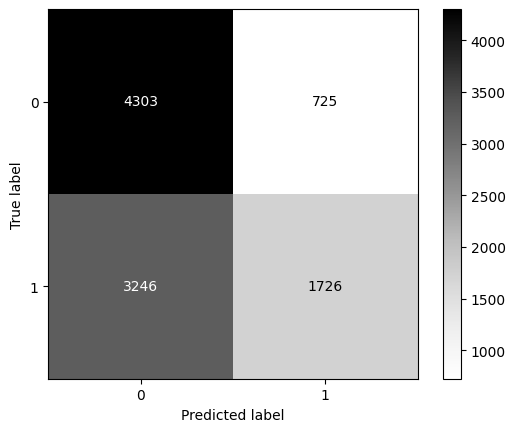
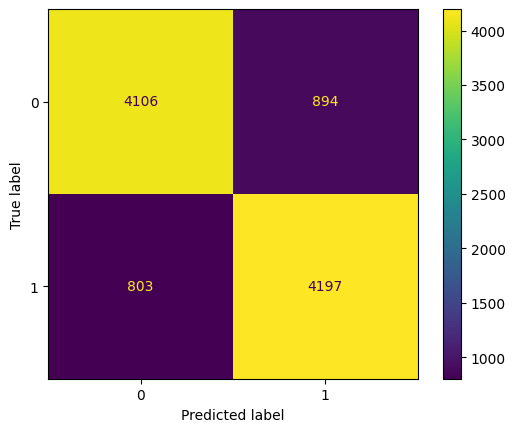
ConfusionMatrixDisplay.from_estimator(model_xgb, X = X_test, y = y_test);
              precision    recall  f1-score   support

           0       0.88      0.85      0.87      5021
           1       0.85      0.88      0.87      4979

    accuracy                           0.87     10000
   macro avg       0.87      0.87      0.87     10000
weighted avg       0.87      0.87      0.87     10000

20.5.1.3 Is our model doing any better than a naive classifier?

Code
from sklearn.dummy import DummyClassifier
X = X_train
y = y_train
dummy_clf = DummyClassifier(strategy="most_frequent")
dummy_clf.fit(X, y)
dummy_clf.score(X, y)
0.500525
Code
dummy_clf.predict_proba(X_train)
array([[0., 1.],
       [0., 1.],
       [0., 1.],
       ...,
       [0., 1.],
       [0., 1.],
       [0., 1.]])

‘prior’ and ‘most_frequent’ are identical except how probabilities are returned. 'most_frequent' returns one-hot probabilities, while 'prior' returns actual probability values.

Code

from sklearn.dummy import DummyClassifier
X = X_train
y = y_train
dummy_clf = DummyClassifier(strategy="prior")
dummy_clf.fit(X, y)
dummy_clf.score(X, y)
0.500525
Code
dummy_clf.predict_proba(X_train)
array([[0.499475, 0.500525],
       [0.499475, 0.500525],
       [0.499475, 0.500525],
       ...,
       [0.499475, 0.500525],
       [0.499475, 0.500525],
       [0.499475, 0.500525]])
Code
dummy_clf = DummyClassifier(strategy="stratified")
dummy_clf.fit(X, y)
dummy_clf.score(X, y)
0.503525
Code
dummy_clf = DummyClassifier(strategy="uniform")
dummy_clf.fit(X, y)
dummy_clf.score(X, y)
0.496675

20.5.2 Movie Review Classification using a Fully Connected NN

Code

from tensorflow.keras.layers import Dense, Conv2D, MaxPooling2D, Dropout, Input, LSTM
from tensorflow import keras

model = keras.Sequential()

model.add(Input(shape=(X_train.shape[1],))) # INPUT layer
model.add(Dense(1000, activation='relu'))
model.add(Dense(1000, activation = 'relu'))
model.add(Dense(1, activation='sigmoid'))
model.summary()
Model: "sequential"
_________________________________________________________________
 Layer (type)                Output Shape              Param #   
=================================================================
 dense (Dense)               (None, 1000)              2001000   
                                                                 
 dense_1 (Dense)             (None, 1000)              1001000   
                                                                 
 dense_2 (Dense)             (None, 1000)              1001000   
                                                                 
 dense_3 (Dense)             (None, 1)                 1001      
                                                                 
=================================================================
Total params: 4004001 (15.27 MB)
Trainable params: 4004001 (15.27 MB)
Non-trainable params: 0 (0.00 Byte)
_________________________________________________________________
Code
callback = tf.keras.callbacks.EarlyStopping(monitor='val_acc', patience=3)
model.compile(optimizer='rmsprop', loss='binary_crossentropy', metrics=['acc'])
history = model.fit(X_train, y_train, epochs=15, batch_size=1000, validation_split=0.2, callbacks= [callback])
Epoch 1/15
32/32 [==============================] - 3s 84ms/step - loss: 0.6704 - acc: 0.6641 - val_loss: 0.5588 - val_acc: 0.6923
Epoch 2/15
32/32 [==============================] - 2s 77ms/step - loss: 0.3990 - acc: 0.8306 - val_loss: 0.4279 - val_acc: 0.8163
Epoch 3/15
32/32 [==============================] - 3s 80ms/step - loss: 0.3253 - acc: 0.8645 - val_loss: 0.2960 - val_acc: 0.8771
Epoch 4/15
32/32 [==============================] - 3s 78ms/step - loss: 0.2841 - acc: 0.8818 - val_loss: 0.3151 - val_acc: 0.8681
Epoch 5/15
32/32 [==============================] - 2s 73ms/step - loss: 0.2606 - acc: 0.8924 - val_loss: 0.2934 - val_acc: 0.8777
Epoch 6/15
32/32 [==============================] - 2s 70ms/step - loss: 0.2396 - acc: 0.9010 - val_loss: 0.2887 - val_acc: 0.8746
Epoch 7/15
32/32 [==============================] - 2s 68ms/step - loss: 0.2068 - acc: 0.9196 - val_loss: 0.3307 - val_acc: 0.8704
Epoch 8/15
32/32 [==============================] - 2s 70ms/step - loss: 0.1903 - acc: 0.9252 - val_loss: 0.3050 - val_acc: 0.8792
Epoch 9/15
32/32 [==============================] - 3s 79ms/step - loss: 0.1730 - acc: 0.9420 - val_loss: 0.2908 - val_acc: 0.8788
Epoch 10/15
32/32 [==============================] - 2s 72ms/step - loss: 0.1208 - acc: 0.9677 - val_loss: 0.3451 - val_acc: 0.8792
Epoch 11/15
32/32 [==============================] - 3s 79ms/step - loss: 0.1162 - acc: 0.9691 - val_loss: 0.3301 - val_acc: 0.8789
Code
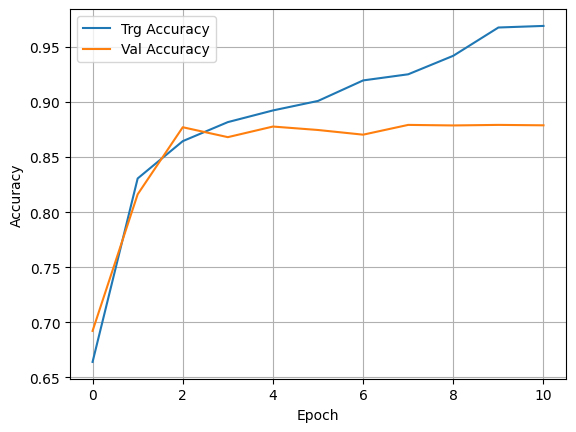
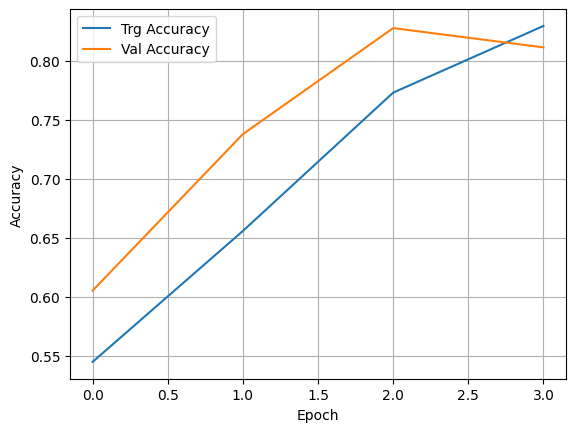
plt.plot(history.history['acc'], label='Trg Accuracy')
plt.plot(history.history['val_acc'], label='Val Accuracy')
plt.xlabel('Epoch')
plt.ylabel('Accuracy')
plt.legend()
plt.grid(True)

Code
pred = model.predict(X_test)
pred =  (pred>.5)*1
313/313 [==============================] - 2s 7ms/step
Code
from sklearn.metrics import confusion_matrix, accuracy_score, classification_report,  ConfusionMatrixDisplay
# Check the classification report and the confusion matrix
print(classification_report(y_true = y_test, y_pred = pred))
ConfusionMatrixDisplay.from_predictions(y_true = y_test, y_pred=pred);
              precision    recall  f1-score   support

           0       0.88      0.87      0.88      5006
           1       0.87      0.88      0.88      4994

    accuracy                           0.88     10000
   macro avg       0.88      0.88      0.88     10000
weighted avg       0.88      0.88      0.88     10000


20.5.3 Movie Review Classification Using an Embedding Layer

Tensorflow Text Vectorization and LSTM network

Code
df = pd.read_csv("IMDB_Dataset.csv")
X = df.review
y = df.sentiment
df
review sentiment
0 One of the other reviewers has mentioned that ... positive
1 A wonderful little production. <br /><br />The... positive
2 I thought this was a wonderful way to spend ti... positive
3 Basically there's a family where a little boy ... negative
4 Petter Mattei's "Love in the Time of Money" is... positive
... ... ...
49995 I thought this movie did a down right good job... positive
49996 Bad plot, bad dialogue, bad acting, idiotic di... negative
49997 I am a Catholic taught in parochial elementary... negative
49998 I'm going to have to disagree with the previou... negative
49999 No one expects the Star Trek movies to be high... negative

50000 rows × 2 columns

Code
max([len(review) for review in X])
13704
Code
from sklearn.model_selection import train_test_split
X_train, X_test, y_train, y_test = train_test_split(X, y, test_size = 0.20)
Code
X_train
33762    I was pretty young when this came out in the U...
45820    Yet another remake of "Fistful of Dollars", Se...
46366    This is an extremely long movie, which means y...
2755     Probably encouraged by admirers of her much-be...
11571    An enjoyable Batman animated film. Not on par ...
                               ...                        
47318    Bon Voyage is fun for the audience because it ...
9270     As far as the movie goes, it's an OK science f...
8637     Pretty visuals and a lot of fights make not a ...
15675    Yuck. I thought it odd that their ancient book...
11139    Laughed a lot - because it is so incredibly ba...
Name: review, Length: 40000, dtype: object

Next, we convert our text data into arrays that neural nets can consume.
These will be used by the several different architectures we will try next.

Code
from keras.preprocessing.text import Tokenizer
from tensorflow.keras.utils import pad_sequences

import numpy as np

maxlen=500  # how many words to take from each text
vocab_size=20000 # the size of our vocabulary

# First, we tokenize our training text
tokenizer = Tokenizer(num_words = vocab_size, oov_token='[UNK]')
tokenizer.fit_on_texts(X_train)

# Create sequences and then the X_train vector
sequences_train = tokenizer.texts_to_sequences(X_train)
word_index = tokenizer.word_index
print('Found %s unique tokens' % len(word_index))
X_train = pad_sequences(sequences_train, maxlen = maxlen)

# Same thing for the y_train vector
sequences_test = tokenizer.texts_to_sequences(X_test)
X_test = pad_sequences(sequences_test, maxlen = maxlen)

# let us encode the labels as 0s and 1s instead of positive and negative
from sklearn.preprocessing import LabelEncoder
le = LabelEncoder()

y_train = le.fit_transform(y_train.values.ravel()) # This needs a 1D array
y_test = le.fit_transform(y_test.values.ravel()) # This needs a 1D array

# Enumerate Encoded Classes
print('Classes', dict(list(enumerate(le.classes_))), '\n')

# Now our y variable contains numbers.  Let us one-hot them using Label Binarizer
# from sklearn.preprocessing import LabelBinarizer
# lb = LabelBinarizer()
# y_train = lb.fit_transform(y_train) 
# y_test = lb.fit_transform(y_test) 


print('Shape of X_train tensor', X_train.shape)
print('Shape of y_train tensor', y_train.shape)
print('Shape of X_test tensor', X_test.shape)
print('Shape of y_test tensor', y_test.shape)


Found 111932 unique tokens
Classes {0: 'negative', 1: 'positive'} 

Shape of X_train tensor (40000, 500)
Shape of y_train tensor (40000,)
Shape of X_test tensor (10000, 500)
Shape of y_test tensor (10000,)
Code
# We can print the word index if we wish to, 
# but be aware it will be a long list

# print(tokenizer.word_index)
Code
X_train[np.random.randint(0,len(X_train))]
array([    0,     0,     0,     0,     0,     0,     0,     0,     0,
           0,     0,     0,     0,     0,     0,     0,     0,     0,
           0,     0,     0,     0,     0,     0,     0,     0,     0,
           0,     0,     0,     0,     0,     0,     0,     0,     0,
           0,     0,     0,     0,     0,     0,     0,     0,     0,
           0,     0,     0,     0,     0,     0,     0,     0,     0,
           0,     0,     0,     0,     0,     0,     0,     0,     0,
           0,     0,     0,     0,     0,     0,     0,     0,     0,
           0,     0,     0,     0,     0,     0,     0,     0,     0,
           0,     0,     0,     0,     0,     0,     0,     0,     0,
           0,     0,     0,     0,     0,     0,     0,     0,     0,
           0,     0,     0,     0,     0,     0,     0,     0,     0,
           0,     0,     0,     0,     0,     0,     0,     0,     0,
           0,     0,     0,     0,     0,     0,     0,     0,     0,
           0,     0,     0,     0,     0,     0,     0,     0,     0,
           0,     0,     0,     0,     0,     0,     0,     0,     0,
           0,     0,     0,     0,     0,     0,     0,     0,     0,
           0,     0,     0,     0,     0,     0,     0,     0,     0,
           0,     0,     0,     0,     0,     0,     0,     0,     0,
           0,     0,     0,     0,     0,     0,     0,     0,     0,
           0,     0,     0,     0,     0,     0,     0,     0,     0,
           0,     0,     0,     0,     0,     0,     0,     0,     0,
           0,     0,     0,     0,     0,     0,     0,     0,     0,
           0,     0,     0,     0,     0,     0,     0,     0,     0,
           0,     0,     0,     0,     0,     0,     0,     0,     0,
           0,     0,     0,     0,     0,     0,     0,     0,     0,
           0,     0,     0,     0,     0,     0,     0,     0,     0,
           0,     0,     0,     0,     0,     0,     0,     0,     0,
           0,     0,     0,     0,     0,     0,     0,     0,     0,
           0,     0,     0,     0,     0,     0,     0,     0,     0,
           0,     0,     0,     0,     0,     0,     0,     0,     0,
           0,     0,     0,     0,     0,     0,     0,     0,     0,
           0,     0,     0,     0,     0,     0,     0,     0,     0,
           0,     0,     0,     0,     0,     0,     0,     0,     0,
           0,     0,     0,     0,     0,     0,     0,     0,     0,
           0,     0,     0,     0,     0,     0,     0,     0,     0,
           0,     0,     0,     0,     0,     0,     0,     0,     0,
           0,     0,     0,     0,     0,     0,     0,     0,     0,
           0,     0,     0,     0,     0,     0,     0,     0,     0,
           0,     0,     0,     0,     0,     0,     0,     4,   796,
           5,   106,  2214,     7,     4,   507,  1199,  3399,  2020,
         178,    13,   314,    69, 10230,     2,    20,  1622,    48,
        6203,   388,     5,  7408,   178,     3,     7,   563,   966,
           2,   398,   175,     5,   150,     7,   375,   315,    17,
         464,  4303, 13942, 18664,   110,   261,   921,     9,     2,
         464,   213,     2,   460,    32,  2822, 19905,     1,     7,
          70,  2404,     3,     2,   628,     7,   422,  1536,     2,
         112,     7,  1062,  1487,    19,    48,   135,    24,  1737,
        3520,     2,   204,     7,   249,   557,    19,    11,    14,
          22,  1084,     9,     2,  4042,    11,    14,   563,  2159,
           3,  4131,     2,   324,   118,     2,    20,   308,   277,
         295,   943,  4144,     3,  3890,     4,   796,     5,   106,
        2214,     7,   339,    17, 13254,     3,     1,    28,     5,
           2,    89,   216,  2119,   178,   105,    11,    26,   124,
         107,   104,    12,   941,    15,   527,    15,   618,    57,
         667,   156,    43,     5,   156])
Code
pd.DataFrame(X_train).sample(6).reset_index(drop=True)
0 1 2 3 4 5 6 7 8 9 ... 490 491 492 493 494 495 496 497 498 499
0 0 0 0 0 0 0 0 0 0 0 ... 7 2 89 431 1023 20 199 107 9 153
1 0 0 0 0 0 0 0 0 0 0 ... 8 48 81 820 200 38 10 16 3460 998
2 0 0 0 0 0 0 0 0 0 0 ... 690 31 2 128 9 193 11 102 45 14709
3 0 0 0 0 0 0 0 0 0 0 ... 1794 638 5 1156 809 1 40 789 12 948
4 0 0 0 0 0 0 0 0 0 0 ... 2 13379 245 21 1697 5268 485 39 2573 211
5 10566 172 655 3665 9 946 46 78 2456 1560 ... 520 2 1355 359 2 940 3 95 797 940

6 rows × 500 columns

Code
word_index['the']
2

Build the model

Code
from tensorflow.keras import Sequential
from tensorflow.keras.layers import Embedding, Flatten, Dense, LSTM, SimpleRNN, Dropout
Code
vocab_size=20000 # vocab size
embedding_dim = 100 # 100 dense vector for each word from Glove
max_len = 350 # using only first 100 words of each review
Code
# In this model, we do not use pre-trained embeddings, but let the machine train the embedding weights too
model = Sequential()
model.add(Embedding(input_dim = vocab_size, output_dim = embedding_dim)) 
# Note that vocab_size=20000 (vocab size), 
# embedding_dim = 100 (100 dense vector for each word from Glove), 
# maxlen=350 (using only first 100 words of each review)
model.add(LSTM(32))
model.add(Dense(1, activation='sigmoid'))
model.summary()
Model: "sequential_1"
_________________________________________________________________
 Layer (type)                Output Shape              Param #   
=================================================================
 embedding (Embedding)       (None, None, 100)         2000000   
                                                                 
 lstm (LSTM)                 (None, 32)                17024     
                                                                 
 dense_4 (Dense)             (None, 1)                 33        
                                                                 
=================================================================
Total params: 2017057 (7.69 MB)
Trainable params: 2017057 (7.69 MB)
Non-trainable params: 0 (0.00 Byte)
_________________________________________________________________

Know that the model in the next cell will take over 30 minutes to train!

Code
%%time
callback = tf.keras.callbacks.EarlyStopping(monitor='val_acc', patience=3)
model.compile(optimizer='rmsprop', loss='binary_crossentropy', metrics=['acc'])
history = model.fit(X_train, y_train, epochs=4, batch_size=1024, validation_split=0.2, callbacks=[callback])
Epoch 1/4
32/32 [==============================] - 136s 4s/step - loss: 0.6908 - acc: 0.5446 - val_loss: 0.6863 - val_acc: 0.6051
Epoch 2/4
32/32 [==============================] - 185s 6s/step - loss: 0.6424 - acc: 0.6558 - val_loss: 0.5378 - val_acc: 0.7380
Epoch 3/4
32/32 [==============================] - 210s 7s/step - loss: 0.5026 - acc: 0.7732 - val_loss: 0.4346 - val_acc: 0.8280
Epoch 4/4
32/32 [==============================] - 208s 7s/step - loss: 0.3993 - acc: 0.8298 - val_loss: 0.4251 - val_acc: 0.8116
CPU times: total: 3min 9s
Wall time: 12min 18s
Code
plt.plot(history.history['acc'], label='Trg Accuracy')
plt.plot(history.history['val_acc'], label='Val Accuracy')
plt.xlabel('Epoch')
plt.ylabel('Accuracy')
plt.legend()
plt.grid(True)

Code
pred = model.predict(X_test)
pred =  (pred>.5)*1
313/313 [==============================] - 17s 52ms/step
Code
from sklearn.metrics import confusion_matrix, accuracy_score, classification_report, ConfusionMatrixDisplay
# Check the classification report and the confusion matrix
print(classification_report(y_true = y_test, y_pred = pred))
ConfusionMatrixDisplay.from_predictions(y_true = y_test, y_pred=pred,cmap='Greys');
              precision    recall  f1-score   support

           0       0.93      0.67      0.78      5028
           1       0.74      0.95      0.83      4972

    accuracy                           0.81     10000
   macro avg       0.83      0.81      0.80     10000
weighted avg       0.83      0.81      0.80     10000

Now imagine you are trying to extract the embedding layer that was just trained.

Code
extracted_embeddings = model.layers[0].get_weights()[0]
Code
extracted_embeddings.shape
(20000, 100)

Let us look at one embedding for the word king

Code
word_index['king']
813
Code
extracted_embeddings[786]
array([-1.14881275e-02, -4.41592261e-02, -4.85331053e-03, -1.27452053e-02,
        1.48207322e-02, -2.81493943e-02, -2.04038695e-02,  7.28135882e-03,
        2.50659920e-02, -2.94143893e-02, -4.46013398e-02, -3.36550735e-02,
        1.63620058e-02,  4.67801951e-02, -1.06137553e-02, -3.36213186e-02,
       -2.73865443e-02, -3.96513101e-03, -3.63592319e-02,  4.53439988e-02,
       -4.48018685e-02,  2.49947738e-02,  2.71193534e-02, -9.99597739e-03,
        1.36841452e-02,  3.64869200e-02,  1.31667387e-02, -5.02903908e-02,
       -2.67941821e-02,  2.96925963e-03,  7.30096130e-04,  4.84319851e-02,
       -4.81315553e-02, -1.93552990e-02, -3.17387953e-02,  6.65677013e-03,
        2.90846545e-02, -3.07342205e-02,  3.25024426e-02,  3.11762001e-02,
       -4.29074951e-02, -4.49494086e-02, -3.50158736e-02, -1.94754936e-02,
        4.34485637e-02,  2.75417510e-02,  3.46044451e-02,  3.01583093e-02,
       -8.66759475e-03,  1.49796726e-02,  2.23229709e-03, -2.59099063e-03,
       -1.17797805e-02,  2.53751893e-02,  3.39713879e-05, -1.29430369e-02,
       -7.12712156e-03, -4.72869538e-02, -4.02695388e-02,  3.96028124e-02,
        3.10590491e-02, -4.99877334e-02,  1.37261450e-02, -1.40058445e-02,
       -1.28269140e-02, -6.73303520e-03, -2.02759691e-02,  1.32153518e-02,
       -4.96231914e-02,  1.72839349e-03,  3.86515372e-02, -1.01006888e-02,
       -9.19216871e-03,  3.77107076e-02, -3.66900004e-02, -4.71480414e-02,
        2.67202109e-02,  1.87980756e-02,  4.52627763e-02, -1.92440394e-02,
        2.75213923e-02,  2.08069049e-02,  2.75107026e-02, -3.14372629e-02,
        3.74295525e-02, -3.80610563e-02,  2.75991093e-02, -1.39205577e-02,
        1.70425195e-02,  2.90865246e-02,  1.34437922e-02, -2.16532145e-02,
        1.49240158e-02,  4.39323904e-03, -3.36699858e-02, -3.51709984e-02,
        2.97581721e-02, -8.05226993e-03,  3.83268893e-02,  1.19277881e-02],
      dtype=float32)

Predicting for a new review

Code
new_review = 'The movie is awful garbage hopeless useless no good'
sequenced_review = tokenizer.texts_to_sequences([new_review])
sequenced_review
[[2, 18, 7, 376, 1220, 4797, 3054, 55, 50]]
Code
padded_review = pad_sequences(sequenced_review, maxlen = maxlen)
predicted_class = model.predict(padded_review)
predicted_class
1/1 [==============================] - 0s 32ms/step
array([[0.25863147]], dtype=float32)
Code
pred = (predicted_class>0.5)*1
int(pred)
C:\Users\user\AppData\Local\Temp\ipykernel_23804\2909965089.py:2: DeprecationWarning: Conversion of an array with ndim > 0 to a scalar is deprecated, and will error in future. Ensure you extract a single element from your array before performing this operation. (Deprecated NumPy 1.25.)
  int(pred)
0
Code
dict(list(enumerate(le.classes_)))
{0: 'negative', 1: 'positive'}
Code
dict(list(enumerate(le.classes_)))[int(pred)]
C:\Users\user\AppData\Local\Temp\ipykernel_23804\2478111763.py:1: DeprecationWarning: Conversion of an array with ndim > 0 to a scalar is deprecated, and will error in future. Ensure you extract a single element from your array before performing this operation. (Deprecated NumPy 1.25.)
  dict(list(enumerate(le.classes_)))[int(pred)]
'negative'

20.5.4 Movie Review Classification Using Pre-trained Glove Embeddings

First, load the Glove embeddings

Code
pwd
'C:\\Users\\user\\Google Drive\\jupyter'
Code
embeddings_index = {}

f=open(r"C:\Users\user\Google Drive\glove.6B\glove.6B.100d.txt", encoding="utf8") # For personal machine
# f=open(r"/home/instructor/shared/glove.6B.100d.txt", encoding="utf8") # For Jupyterhub at NYU
for line in f:
    values = line.split()
    word = values[0]
    coefs = np.asarray(values[1:], dtype = 'float32')
    embeddings_index[word] = coefs
f.close()

print('Found %s words and corresponding vectors' % len(embeddings_index))
vocab_size = len(embeddings_index)
Found 400000 words and corresponding vectors
Code
# Print the embeddings_index (if needed)

# embeddings_index
Code
embeddings_index['the']
array([-0.038194, -0.24487 ,  0.72812 , -0.39961 ,  0.083172,  0.043953,
       -0.39141 ,  0.3344  , -0.57545 ,  0.087459,  0.28787 , -0.06731 ,
        0.30906 , -0.26384 , -0.13231 , -0.20757 ,  0.33395 , -0.33848 ,
       -0.31743 , -0.48336 ,  0.1464  , -0.37304 ,  0.34577 ,  0.052041,
        0.44946 , -0.46971 ,  0.02628 , -0.54155 , -0.15518 , -0.14107 ,
       -0.039722,  0.28277 ,  0.14393 ,  0.23464 , -0.31021 ,  0.086173,
        0.20397 ,  0.52624 ,  0.17164 , -0.082378, -0.71787 , -0.41531 ,
        0.20335 , -0.12763 ,  0.41367 ,  0.55187 ,  0.57908 , -0.33477 ,
       -0.36559 , -0.54857 , -0.062892,  0.26584 ,  0.30205 ,  0.99775 ,
       -0.80481 , -3.0243  ,  0.01254 , -0.36942 ,  2.2167  ,  0.72201 ,
       -0.24978 ,  0.92136 ,  0.034514,  0.46745 ,  1.1079  , -0.19358 ,
       -0.074575,  0.23353 , -0.052062, -0.22044 ,  0.057162, -0.15806 ,
       -0.30798 , -0.41625 ,  0.37972 ,  0.15006 , -0.53212 , -0.2055  ,
       -1.2526  ,  0.071624,  0.70565 ,  0.49744 , -0.42063 ,  0.26148 ,
       -1.538   , -0.30223 , -0.073438, -0.28312 ,  0.37104 , -0.25217 ,
        0.016215, -0.017099, -0.38984 ,  0.87424 , -0.72569 , -0.51058 ,
       -0.52028 , -0.1459  ,  0.8278  ,  0.27062 ], dtype=float32)
Code
len(embeddings_index.get('security'))
100
Code
print(embeddings_index.get('th13e'))
None
Code
y_test
array([0, 1, 0, ..., 1, 1, 0])
Code
list(embeddings_index.keys())[3]
'of'
Code
vocab_size
400000
Code
# Create the embedding matrix based on Glove
embedding_dim = 100
embedding_matrix = np.zeros((vocab_size, embedding_dim))
for i, word in enumerate(list(embeddings_index.keys())):
    # print(word,i)
    if i < vocab_size:
        embedding_vector = embeddings_index.get(word)
        if embedding_vector is not None:
            embedding_matrix[i] = embedding_vector
            
Code
embedding_matrix.shape
(400000, 100)
Code
embedding_matrix[0]
array([-0.038194  , -0.24487001,  0.72812003, -0.39961001,  0.083172  ,
        0.043953  , -0.39140999,  0.3344    , -0.57545   ,  0.087459  ,
        0.28786999, -0.06731   ,  0.30906001, -0.26383999, -0.13231   ,
       -0.20757   ,  0.33395001, -0.33848   , -0.31742999, -0.48335999,
        0.1464    , -0.37303999,  0.34577   ,  0.052041  ,  0.44946   ,
       -0.46970999,  0.02628   , -0.54154998, -0.15518001, -0.14106999,
       -0.039722  ,  0.28277001,  0.14393   ,  0.23464   , -0.31020999,
        0.086173  ,  0.20397   ,  0.52623999,  0.17163999, -0.082378  ,
       -0.71787   , -0.41531   ,  0.20334999, -0.12763   ,  0.41367   ,
        0.55186999,  0.57907999, -0.33476999, -0.36559001, -0.54856998,
       -0.062892  ,  0.26583999,  0.30204999,  0.99774998, -0.80480999,
       -3.0243001 ,  0.01254   , -0.36941999,  2.21670008,  0.72201002,
       -0.24978   ,  0.92136002,  0.034514  ,  0.46744999,  1.10790002,
       -0.19358   , -0.074575  ,  0.23353   , -0.052062  , -0.22044   ,
        0.057162  , -0.15806   , -0.30798   , -0.41624999,  0.37972   ,
        0.15006   , -0.53211999, -0.20550001, -1.25259995,  0.071624  ,
        0.70564997,  0.49744001, -0.42063001,  0.26148   , -1.53799999,
       -0.30223   , -0.073438  , -0.28312001,  0.37103999, -0.25217   ,
        0.016215  , -0.017099  , -0.38984001,  0.87423998, -0.72569001,
       -0.51058   , -0.52028   , -0.1459    ,  0.82779998,  0.27061999])

At this point the embedding_matrix has one row per word in the vocabulary. Each row has the vector for that word, picked from glove. Because it is an np.array, it has no row or column names. The order of the words in the rows is the same as the order of words in the dict embeddings_index.

We will feed this embedding matrix as weights to the embedding layer.

Build the model:

Code
from tensorflow.keras import Sequential
from tensorflow.keras.layers import Embedding, Flatten, Dense, LSTM, SimpleRNN, Dropout
Code
# let us use pretrained Glove embeddings

model = Sequential()
model.add(Embedding(input_dim = vocab_size, output_dim = embedding_dim,
                    embeddings_initializer=keras.initializers.Constant(embedding_matrix),
                    trainable=False,mask_zero=True )) # Note that vocab_size=20000 (vocab size), embedding_dim = 100 (100 dense vector for each word from Glove), maxlen=350 (using only first 100 words of each review)
model.add(LSTM(32, name='LSTM_Layer'))
model.add(Dense(1, activation='sigmoid'))
model.summary()
Model: "sequential_2"
_________________________________________________________________
 Layer (type)                Output Shape              Param #   
=================================================================
 embedding_1 (Embedding)     (None, None, 100)         40000000  
                                                                 
 LSTM_Layer (LSTM)           (None, 32)                17024     
                                                                 
 dense_5 (Dense)             (None, 1)                 33        
                                                                 
=================================================================
Total params: 40017057 (152.65 MB)
Trainable params: 17057 (66.63 KB)
Non-trainable params: 40000000 (152.59 MB)
_________________________________________________________________
Code
# Takes 30 minutes to train

callback = tf.keras.callbacks.EarlyStopping(monitor='val_acc', patience=3)
model.compile(optimizer='rmsprop', loss='binary_crossentropy', metrics=['acc'])
history = model.fit(X_train, y_train, epochs=4, batch_size=1024, validation_split=0.2, callbacks=[callback])
Epoch 1/4
32/32 [==============================] - 155s 5s/step - loss: 0.6956 - acc: 0.5199 - val_loss: 0.6848 - val_acc: 0.5543
Epoch 2/4
32/32 [==============================] - 151s 5s/step - loss: 0.6805 - acc: 0.5609 - val_loss: 0.6720 - val_acc: 0.5863
Epoch 3/4
32/32 [==============================] - 158s 5s/step - loss: 0.6707 - acc: 0.5847 - val_loss: 0.6953 - val_acc: 0.5361
Epoch 4/4
32/32 [==============================] - 163s 5s/step - loss: 0.6635 - acc: 0.5954 - val_loss: 0.6638 - val_acc: 0.5957
Code
plt.plot(history.history['acc'], label='Trg Accuracy')
plt.plot(history.history['val_acc'], label='Val Accuracy')
plt.xlabel('Epoch')
plt.ylabel('Accuracy')
plt.legend()
plt.grid(True)

Code
pred = model.predict(X_test)
pred =  (pred>.5)*1
313/313 [==============================] - 25s 74ms/step
Code
from sklearn.metrics import confusion_matrix, accuracy_score, classification_report,  ConfusionMatrixDisplay
# Check the classification report and the confusion matrix
print(classification_report(y_true = y_test, y_pred = pred))
ConfusionMatrixDisplay.from_predictions(y_true = y_test, y_pred=pred,cmap='Greys');
              precision    recall  f1-score   support

           0       0.57      0.86      0.68      5028
           1       0.70      0.35      0.47      4972

    accuracy                           0.60     10000
   macro avg       0.64      0.60      0.57     10000
weighted avg       0.64      0.60      0.58     10000


CAREFUL WHEN RUNNING ON JUPYTERHUB!!! Jupyterhub may crash, or will not have the storage space to store the pretrained models. If you wish to test this out, run it on your own machine.

20.6 Word2Vec

20.6.1 Using pre-trained embeddings

You can list all the different types of pre-trained embeddings you can download from Gensim

Code
# import os
# os.environ['GENSIM_DATA_DIR'] = '/home/instructor/shared/gensim'
Code
# Source: https://radimrehurek.com/gensim/auto_examples/howtos/run_downloader_api.html

import gensim.downloader as api
info = api.info()

for model_name, model_data in sorted(info['models'].items()):
    print(
        '%s (%d records): %s' % (
            model_name,
            model_data.get('num_records', -1),
            model_data['description'][:40] + '...',
        )
    )
__testing_word2vec-matrix-synopsis (-1 records): [THIS IS ONLY FOR TESTING] Word vecrors ...
conceptnet-numberbatch-17-06-300 (1917247 records): ConceptNet Numberbatch consists of state...
fasttext-wiki-news-subwords-300 (999999 records): 1 million word vectors trained on Wikipe...
glove-twitter-100 (1193514 records): Pre-trained vectors based on  2B tweets,...
glove-twitter-200 (1193514 records): Pre-trained vectors based on 2B tweets, ...
glove-twitter-25 (1193514 records): Pre-trained vectors based on 2B tweets, ...
glove-twitter-50 (1193514 records): Pre-trained vectors based on 2B tweets, ...
glove-wiki-gigaword-100 (400000 records): Pre-trained vectors based on Wikipedia 2...
glove-wiki-gigaword-200 (400000 records): Pre-trained vectors based on Wikipedia 2...
glove-wiki-gigaword-300 (400000 records): Pre-trained vectors based on Wikipedia 2...
glove-wiki-gigaword-50 (400000 records): Pre-trained vectors based on Wikipedia 2...
word2vec-google-news-300 (3000000 records): Pre-trained vectors trained on a part of...
word2vec-ruscorpora-300 (184973 records): Word2vec Continuous Skipgram vectors tra...
Code
import gensim.downloader as api
wv = api.load('glove-wiki-gigaword-50')
Code
wv.similarity('ship', 'marshmallow')
-0.046069
Code
wv.similarity('up', 'down')
0.9523452
Code
wv.most_similar(positive=['plot'], topn=5)
[('plots', 0.8182128071784973),
 ('plotting', 0.7718315124511719),
 ('plotted', 0.7407090067863464),
 ('conspiracy', 0.7254624366760254),
 ('secret', 0.6929571032524109)]
Code
# king - queen = princess - prince
# king = + queen + princess - prince
wv.most_similar(positive=['queen', 'prince'], negative = ['princess'], topn=5)
[('king', 0.8574749827384949),
 ('patron', 0.7256798148155212),
 ('crown', 0.7167519330978394),
 ('throne', 0.7129824161529541),
 ('edward', 0.7081639170646667)]
Code
wv.doesnt_match(['fire', 'water', 'land', 'sea', 'air'])
'land'
Code
wv['car'].shape
(50,)
Code
wv['car']
array([ 0.47685 , -0.084552,  1.4641  ,  0.047017,  0.14686 ,  0.5082  ,
       -1.2228  , -0.22607 ,  0.19306 , -0.29756 ,  0.20599 , -0.71284 ,
       -1.6288  ,  0.17096 ,  0.74797 , -0.061943, -0.65766 ,  1.3786  ,
       -0.68043 , -1.7551  ,  0.58319 ,  0.25157 , -1.2114  ,  0.81343 ,
        0.094825, -1.6819  , -0.64498 ,  0.6322  ,  1.1211  ,  0.16112 ,
        2.5379  ,  0.24852 , -0.26816 ,  0.32818 ,  1.2916  ,  0.23548 ,
        0.61465 , -0.1344  , -0.13237 ,  0.27398 , -0.11821 ,  0.1354  ,
        0.074306, -0.61951 ,  0.45472 , -0.30318 , -0.21883 , -0.56054 ,
        1.1177  , -0.36595 ], dtype=float32)
Code
# # Create the embedding matrix based on Word2Vec
# # The code below is to be used if Word2Vec based embedding is to be applied
# embedding_dim = 300
# embedding_matrix = np.zeros((vocab_size, embedding_dim))
# for word, i in word_index.items():
#     if i < vocab_size:
#         try:
#             embedding_vector = wv[word]
#         except:
#             pass
#         if embedding_vector is not None:
#             embedding_matrix[i] = embedding_vector
 

20.6.2 Train your own Word2Vec model

Source: https://radimrehurek.com/gensim/auto_examples/tutorials/run_word2vec.html

Word2Vec vs modern embeddings: Training a custom Word2Vec model (as below) gives you domain-specific embeddings and is still worth doing when your text domain is highly specialised (medical, legal, financial jargon). For general-purpose English text, pre-trained sentence-transformers are faster to deploy and usually more accurate: SentenceTransformer('all-mpnet-base-v2') produces 768-dim embeddings trained on 1 billion sentence pairs. For multilingual tasks, paraphrase-multilingual-MiniLM-L12-v2 covers 50+ languages out of the box.

Code
df = pd.read_csv("IMDB_Dataset.csv")
X = df.review
y = df.sentiment
df
review sentiment
0 One of the other reviewers has mentioned that ... positive
1 A wonderful little production. <br /><br />The... positive
2 I thought this was a wonderful way to spend ti... positive
3 Basically there's a family where a little boy ... negative
4 Petter Mattei's "Love in the Time of Money" is... positive
... ... ...
49995 I thought this movie did a down right good job... positive
49996 Bad plot, bad dialogue, bad acting, idiotic di... negative
49997 I am a Catholic taught in parochial elementary... negative
49998 I'm going to have to disagree with the previou... negative
49999 No one expects the Star Trek movies to be high... negative

50000 rows × 2 columns

Code
text = X.str.split()
text
0        [One, of, the, other, reviewers, has, mentione...
1        [A, wonderful, little, production., <br, /><br...
2        [I, thought, this, was, a, wonderful, way, to,...
3        [Basically, there's, a, family, where, a, litt...
4        [Petter, Mattei's, "Love, in, the, Time, of, M...
                               ...                        
49995    [I, thought, this, movie, did, a, down, right,...
49996    [Bad, plot,, bad, dialogue,, bad, acting,, idi...
49997    [I, am, a, Catholic, taught, in, parochial, el...
49998    [I'm, going, to, have, to, disagree, with, the...
49999    [No, one, expects, the, Star, Trek, movies, to...
Name: review, Length: 50000, dtype: object
Code
%%time
import gensim.models
# Next, you train the model.  Lots of parameters available.  The default model type
# is CBOW, which you can change to SG by setting sg=1

model = gensim.models.Word2Vec(sentences=text, vector_size=100)
CPU times: total: 18.6 s
Wall time: 24.8 s
Code
for index, word in enumerate(model.wv.index_to_key):
    if index == 10:
        break
    print(f"word #{index}/{len(model.wv.index_to_key)} is {word}")
word #0/76833 is the
word #1/76833 is a
word #2/76833 is and
word #3/76833 is of
word #4/76833 is to
word #5/76833 is is
word #6/76833 is in
word #7/76833 is I
word #8/76833 is that
word #9/76833 is this
Code
model.wv.most_similar(positive=['plot'], topn=5)
[('storyline', 0.8623475432395935),
 ('story', 0.802622377872467),
 ('plot,', 0.801565408706665),
 ('premise', 0.7574442625045776),
 ('script', 0.7303113341331482)]
Code
model.wv.most_similar(positive=['picture'], topn=5)
[('film', 0.7727681398391724),
 ('movie', 0.7152172923088074),
 ('picture,', 0.6822035908699036),
 ('film,', 0.6663559675216675),
 ('picture.', 0.6313234567642212)]
Code
model.wv.doesnt_match(['violence', 'comedy', 'hollywood', 'action', 'tragedy', 'mystery'])
'hollywood'
Code
model.wv['car']
array([ 1.9184788 , -0.39828682, -3.0497658 ,  1.162363  ,  1.3929547 ,
        0.73242277,  0.95298696,  0.6758191 ,  1.3006241 , -1.6236212 ,
        3.9134579 , -1.2583504 , -2.0008836 , -0.86899066, -0.63415515,
       -1.4440541 ,  1.8872882 ,  0.84577435,  2.1984234 , -1.7293    ,
       -0.11701463, -0.4169316 , -0.7939858 ,  1.0183135 ,  0.16227342,
       -2.2215946 , -0.70099163,  0.43473026, -1.6678154 ,  2.121353  ,
        0.19150172, -0.47383904, -1.6977563 , -2.3342447 ,  0.06500984,
        0.7027349 ,  2.4686372 ,  1.6673396 ,  1.0421041 ,  0.92360365,
       -1.2118206 , -0.49564028, -0.4385476 ,  1.6923317 , -0.36909676,
       -2.3004282 , -2.4018247 ,  0.5466857 ,  1.1344895 , -0.76052487,
       -1.851937  , -0.887899  , -0.90922797, -0.89403564,  0.31427276,
       -1.7317183 , -1.9672406 , -0.6664012 ,  2.4840136 ,  0.9176966 ,
       -1.235118  , -1.81105   ,  0.04874192, -0.43327668, -2.336604  ,
        1.0734081 ,  1.7877102 ,  0.7888886 , -0.8859155 ,  0.4724213 ,
       -0.58811104,  2.2307591 , -0.6617877 , -1.6993963 ,  0.44520825,
        1.1593628 , -0.99356115,  1.8925456 ,  0.02265957, -0.86020654,
       -0.26626486,  1.2915838 , -0.5562167 ,  0.11651267,  1.8843534 ,
       -0.05203766, -0.25424278,  0.22551784,  1.3291271 ,  0.8917808 ,
       -2.335943  ,  2.6117947 ,  0.71869457,  2.4364202 ,  1.3901333 ,
       -2.531578  , -1.2317238 ,  2.7760105 , -0.5455952 ,  1.823137  ],
      dtype=float32)
Code
# model.wv.key_to_index 

list(model.wv.key_to_index.items())[:20]
[('the', 0),
 ('a', 1),
 ('and', 2),
 ('of', 3),
 ('to', 4),
 ('is', 5),
 ('in', 6),
 ('I', 7),
 ('that', 8),
 ('this', 9),
 ('it', 10),
 ('/><br', 11),
 ('was', 12),
 ('as', 13),
 ('with', 14),
 ('for', 15),
 ('The', 16),
 ('but', 17),
 ('on', 18),
 ('movie', 19)]
Code
model.wv.index_to_key[:20]
['the',
 'a',
 'and',
 'of',
 'to',
 'is',
 'in',
 'I',
 'that',
 'this',
 'it',
 '/><br',
 'was',
 'as',
 'with',
 'for',
 'The',
 'but',
 'on',
 'movie']

20.6.3 Identify text that is similar

We will calculate the similarity between vectors to identify the most similar reviews.

Before we do it for everything, let us pick two random reviews and compute the similarity between them.

To make things simpler, first let us reduce the size of our dataset to 5,000 reviews (instead of 50,000)

Code
df = df.sample(5000) # We limit, for illustration, to 1000 random reviews
Code
df.review.iloc[2]
'Superman II - The Richard Donner Cut should be a fan\'s dream come true. At long last, footage only seen in photos and scenes that only existed on the printed page would finally come to life. A director that was unable to complete his vision would have the opportunity to have his vision restored. It seems like a winning situation. And then you start watching this assembly of footage and you realize this "esoteric dream" is a very real nightmare of sloppiness and incompetence. While it\'s entirely possible that no movie could compete with the finished perfect version each of us has imagined over the years it really should have been a thrill to finally see this project. And it is only a very few times.<br /><br />You know things are shaky when the very first bit of text on screen looks like home brew computer graphics. But then we start seeing new footage (alternates from Superman - The Movie for the trial) and that first bit of hesitation fades away. Hey, this is pretty neat! Things are alright for these few fleeting moments until we see footage from STM intermixed with new effects for this project, and it doesn\'t convince at all. And from this point on, it never ever lets up. It\'s probably not right to judge a movie because of bad visual effects, but when this is supposedly the direct follow up to a movie whose tag line was "You\'ll Believe A Man Can Fly" it\'s difficult to believe anything shown on screen here. The best effects in this are from the original productions.<br /><br />Another issue with this re-cut. A lot of it just doesn\'t make sense. The only reason any of it really works is because we\'ve all seen the theatrical version of Superman II, a movie that does make sense. Lester\'s Superman II fills in the holes of this assembly. Part of this could be because Donner didn\'t get to complete shooting, the other part could be because the makers of this project were intent on using as little Lester material as possible. What we end up with is an assembly of footage that makes Superman IV look airtight and coherent.<br /><br />After viewing this, one gets the sense that while Lester was faithful and comfortable using Donner material, Michael Thau and his team were extremely disrespectful towards anything filmed by Lester. The best scenes in The Donner Cut are the ones lifted relatively intact from the released version of Superman II. That includes the moon sequence and the diner sequence, not ironically, both were filmed by Donner. But anything else from that movie filmed by Lester is re-edited in such a hasty fashion, that it now makes Lester seem like a ham fisted know nothing. While Lester honored the Donner material, Lester here is thrown under the bus.<br /><br />So is there anything good in this release? Well Marlon Brando is in it, and that\'s neat to see. In fact watching any of the material shot by Donner is neat since it was all filmed at the same time as Superman - The Movie. But that only highlights the problems of this release. Any of the major scenes (really just Lois jumping and scenes with Marlon Brando) would have been better served as completed scenes in a deleted scenes section. Instead they are shoe horned into a nonsensical narrative with inferior performances (many alternate takes from familiar scenes are used) sloppy edits and bad decisions.<br /><br />Watch the opening scene at the Daily Planet. Why are we looking at Jackie Cooper\'s back as he calls for Lois and Clark? At the end why do we have Lois walking into her dark apartment only to have that followed by Jackie Cooper walking into a dark bathroom turning the lights on? I was initially confused by this, because I expected to see Lois. The entire assembly is filled with questionable choices like this.<br /><br />Battle scenes are a mess too, with no geography between cuts. It\'s just random action. Of course, the major action scenes were shot by Lester and his material is only used as a bridge to the next set of Donner outtakes or alternates. They should have used more of Lester\'s footage, but probably had too much pride to admit that.<br /><br />The sloppiness extends to the military missile as well. As noted elsewhere, the missile shown in The Donner Cut bears the designation "XK 10" while we all know it\'s the "XK 101"! A blind man in STM knows that! The producers of this assembly, who tried so hard to honor the original film, dropped the ball less than five minutes in and that mistake is indicative of the quality of the entire production. For all the supposed care that was put into this, the final product has an air of shoddiness to it that is inescapable.<br /><br />The entire affair would probably be easier to digest if Warner\'s didn\'t make this a separate release here in the states. As it is, we\'re expected to pay for what is essentially a bonus disc of deleted scenes with a "Play All" option. It\'s really only worth one viewing so that we can finally see the legendary cut scenes, but after that initial viewing, I expect that this will be an excellent magnet for dust and little else. I know after my experience of watching this, I had new respect for Lester\'s version. It\'s by no means perfect, but Lester realized the deficiencies that were in the script that stand out here in bold relief. He managed to make a movie that has entertained for many years and will continue to do so, while this new re-cut will most likely only be remembered as a footnote in that films history.'
Code
df.review.iloc[20]
'Family Guy is THE best show on TV. EVER. It has achieved great things that no other animated sitcom, or any show, has even come close to achieving.<br /><br />In terms of animated sitcoms, this era should be referred to as "The Era of Animated Sitcoms" because there are so many of them, and almost every one of them imaginable is being released on DVD. There are some good ones (i.e. South Park, Futurama, and The Simpsons). Every animated sitcom has its own style/technique of creating humor. For instance, Futurama is funny because it always comments or acts on what just happened with a touch of humor. The Simpsons is also a great show because it uses the same comedic technique and style that Futurama does, but The Simpsons deserves the credit for it since it was on the air way before Futurama and still remains on the air using the technique. South Park, in my mind, is the funniest show next to Family Guy, because it uses a smart blend of vulgarity and silliness as it\'s technique of creating humor.<br /><br />But enough about other animated shows. Let me tell you what makes Family Guy so funny. Family Guy uses a comedic style that no other show has ever used before. It uses a technique of having flashbacks occur after every joke. This not only reinforces the joke, but makes it seem funnier. It also moves at a very quick pace. These two criteria make it the funniest show on TV. You have to see the show to believe it, but once you see it, you will most likely agree. (FYI, the two funniest moments on Family Guy were: 1) The 5 minute chicken fight in "Da Boom", and 2) The Dick van Dyke spoof in "Holy Crap.") Also, in my mind Family Guy is a very modest show because while other shows create humor by getting familiar with their shticks/routines and characters, most of Family Guy\'s jokes are based on the silliness of current events and pop culture. This also shows that Family Guy is intelligent, in addition to being modest, because it reveals that the show has insight. And this technique is extremely effective because they relate their pop culture references to the particular plot of the episode they are found in.<br /><br />Family Guy can be enjoyed by all ages, because while younger children may not understand the pop culture references, they will be amused by the hilarious, silly antics of the characters, especially Peter. The show is, however, a little bit more vulgar than The Simpsons and Futurama, but it is less vulgar than South Park. So, in terms of vulgarity, Family Guy would rank somewhere in the middle when associated with the above shows, but it would rank No. 1 in terms humor and intelligence!!<br /><br />Sadly, it was cancelled last year, not because it wasn\'t popular, but because FOX kept changing it\'s time slot, so no one ever knew when it was on. Luckily, we\'ve got the DVD box sets (which, by the way, are selling like crazy) and reruns on Cartoon Network\'s Adult Swim available to us.'
Code
# We take the above reviews and split by word, and put them in a list
# Word2vec will need these as a list

first = [x for x in df.review.iloc[2].split() if x in model.wv.key_to_index]
second = [x for x in df.review.iloc[20].split() if x in model.wv.key_to_index]
Code
print(first)
['Superman', 'II', '-', 'The', 'Richard', 'Donner', 'Cut', 'should', 'be', 'a', "fan's", 'dream', 'come', 'true.', 'At', 'long', 'last,', 'footage', 'only', 'seen', 'in', 'photos', 'and', 'scenes', 'that', 'only', 'existed', 'on', 'the', 'printed', 'page', 'would', 'finally', 'come', 'to', 'life.', 'A', 'director', 'that', 'was', 'unable', 'to', 'complete', 'his', 'vision', 'would', 'have', 'the', 'opportunity', 'to', 'have', 'his', 'vision', 'restored.', 'It', 'seems', 'like', 'a', 'winning', 'situation.', 'And', 'then', 'you', 'start', 'watching', 'this', 'assembly', 'of', 'footage', 'and', 'you', 'realize', 'this', 'dream"', 'is', 'a', 'very', 'real', 'nightmare', 'of', 'sloppiness', 'and', 'incompetence.', 'While', "it's", 'entirely', 'possible', 'that', 'no', 'movie', 'could', 'compete', 'with', 'the', 'finished', 'perfect', 'version', 'each', 'of', 'us', 'has', 'imagined', 'over', 'the', 'years', 'it', 'really', 'should', 'have', 'been', 'a', 'thrill', 'to', 'finally', 'see', 'this', 'project.', 'And', 'it', 'is', 'only', 'a', 'very', 'few', 'times.<br', '/><br', '/>You', 'know', 'things', 'are', 'shaky', 'when', 'the', 'very', 'first', 'bit', 'of', 'text', 'on', 'screen', 'looks', 'like', 'home', 'brew', 'computer', 'graphics.', 'But', 'then', 'we', 'start', 'seeing', 'new', 'footage', 'from', 'Superman', '-', 'The', 'Movie', 'for', 'the', 'and', 'that', 'first', 'bit', 'of', 'hesitation', 'fades', 'away.', 'Hey,', 'this', 'is', 'pretty', 'Things', 'are', 'alright', 'for', 'these', 'few', 'fleeting', 'moments', 'until', 'we', 'see', 'footage', 'from', 'with', 'new', 'effects', 'for', 'this', 'project,', 'and', 'it', "doesn't", 'convince', 'at', 'all.', 'And', 'from', 'this', 'point', 'on,', 'it', 'never', 'ever', 'lets', 'up.', "It's", 'probably', 'not', 'right', 'to', 'judge', 'a', 'movie', 'because', 'of', 'bad', 'visual', 'effects,', 'but', 'when', 'this', 'is', 'supposedly', 'the', 'direct', 'follow', 'up', 'to', 'a', 'movie', 'whose', 'tag', 'line', 'was', '"You\'ll', 'Believe', 'A', 'Man', 'Can', 'Fly"', "it's", 'difficult', 'to', 'believe', 'anything', 'shown', 'on', 'screen', 'here.', 'The', 'best', 'effects', 'in', 'this', 'are', 'from', 'the', 'original', 'productions.<br', '/><br', '/>Another', 'issue', 'with', 'this', 'A', 'lot', 'of', 'it', 'just', "doesn't", 'make', 'sense.', 'The', 'only', 'reason', 'any', 'of', 'it', 'really', 'works', 'is', 'because', "we've", 'all', 'seen', 'the', 'theatrical', 'version', 'of', 'Superman', 'II,', 'a', 'movie', 'that', 'does', 'make', 'sense.', "Lester's", 'Superman', 'II', 'fills', 'in', 'the', 'holes', 'of', 'this', 'Part', 'of', 'this', 'could', 'be', 'because', 'Donner', "didn't", 'get', 'to', 'complete', 'shooting,', 'the', 'other', 'part', 'could', 'be', 'because', 'the', 'makers', 'of', 'this', 'project', 'were', 'intent', 'on', 'using', 'as', 'little', 'Lester', 'material', 'as', 'possible.', 'What', 'we', 'end', 'up', 'with', 'is', 'an', 'assembly', 'of', 'footage', 'that', 'makes', 'Superman', 'IV', 'look', 'and', '/><br', '/>After', 'viewing', 'this,', 'one', 'gets', 'the', 'sense', 'that', 'while', 'Lester', 'was', 'faithful', 'and', 'comfortable', 'using', 'Donner', 'material,', 'Michael', 'and', 'his', 'team', 'were', 'extremely', 'disrespectful', 'towards', 'anything', 'filmed', 'by', 'Lester.', 'The', 'best', 'scenes', 'in', 'The', 'Donner', 'Cut', 'are', 'the', 'ones', 'lifted', 'relatively', 'intact', 'from', 'the', 'released', 'version', 'of', 'Superman', 'II.', 'That', 'includes', 'the', 'moon', 'sequence', 'and', 'the', 'diner', 'sequence,', 'not', 'ironically,', 'both', 'were', 'filmed', 'by', 'But', 'anything', 'else', 'from', 'that', 'movie', 'filmed', 'by', 'Lester', 'is', 're-edited', 'in', 'such', 'a', 'hasty', 'fashion,', 'that', 'it', 'now', 'makes', 'Lester', 'seem', 'like', 'a', 'ham', 'fisted', 'know', 'nothing.', 'While', 'Lester', 'honored', 'the', 'Donner', 'material,', 'Lester', 'here', 'is', 'thrown', 'under', 'the', '/><br', '/>So', 'is', 'there', 'anything', 'good', 'in', 'this', 'release?', 'Well', 'Marlon', 'Brando', 'is', 'in', 'it,', 'and', "that's", 'neat', 'to', 'see.', 'In', 'fact', 'watching', 'any', 'of', 'the', 'material', 'shot', 'by', 'Donner', 'is', 'neat', 'since', 'it', 'was', 'all', 'filmed', 'at', 'the', 'same', 'time', 'as', 'Superman', '-', 'The', 'Movie.', 'But', 'that', 'only', 'highlights', 'the', 'problems', 'of', 'this', 'release.', 'Any', 'of', 'the', 'major', 'scenes', '(really', 'just', 'Lois', 'jumping', 'and', 'scenes', 'with', 'Marlon', 'Brando)', 'would', 'have', 'been', 'better', 'served', 'as', 'completed', 'scenes', 'in', 'a', 'deleted', 'scenes', 'section.', 'Instead', 'they', 'are', 'shoe', 'horned', 'into', 'a', 'nonsensical', 'narrative', 'with', 'inferior', 'performances', '(many', 'alternate', 'takes', 'from', 'familiar', 'scenes', 'are', 'used)', 'sloppy', 'edits', 'and', 'bad', '/><br', '/>Watch', 'the', 'opening', 'scene', 'at', 'the', 'Daily', 'Why', 'are', 'we', 'looking', 'at', 'Jackie', "Cooper's", 'back', 'as', 'he', 'calls', 'for', 'Lois', 'and', 'At', 'the', 'end', 'why', 'do', 'we', 'have', 'Lois', 'walking', 'into', 'her', 'dark', 'apartment', 'only', 'to', 'have', 'that', 'followed', 'by', 'Jackie', 'Cooper', 'walking', 'into', 'a', 'dark', 'bathroom', 'turning', 'the', 'lights', 'on?', 'I', 'was', 'initially', 'confused', 'by', 'this,', 'because', 'I', 'expected', 'to', 'see', 'The', 'entire', 'assembly', 'is', 'filled', 'with', 'questionable', 'choices', 'like', 'this.<br', '/><br', 'scenes', 'are', 'a', 'mess', 'too,', 'with', 'no', 'geography', 'between', 'cuts.', "It's", 'just', 'random', 'action.', 'Of', 'course,', 'the', 'major', 'action', 'scenes', 'were', 'shot', 'by', 'Lester', 'and', 'his', 'material', 'is', 'only', 'used', 'as', 'a', 'bridge', 'to', 'the', 'next', 'set', 'of', 'Donner', 'outtakes', 'or', 'They', 'should', 'have', 'used', 'more', 'of', "Lester's", 'footage,', 'but', 'probably', 'had', 'too', 'much', 'pride', 'to', 'admit', 'that.<br', '/><br', '/>The', 'sloppiness', 'extends', 'to', 'the', 'military', 'missile', 'as', 'well.', 'As', 'noted', 'elsewhere,', 'the', 'missile', 'shown', 'in', 'The', 'Donner', 'Cut', 'bears', 'the', '10"', 'while', 'we', 'all', 'know', "it's", 'the', 'A', 'blind', 'man', 'in', 'knows', 'that!', 'The', 'producers', 'of', 'this', 'who', 'tried', 'so', 'hard', 'to', 'honor', 'the', 'original', 'film,', 'dropped', 'the', 'ball', 'less', 'than', 'five', 'minutes', 'in', 'and', 'that', 'mistake', 'is', 'indicative', 'of', 'the', 'quality', 'of', 'the', 'entire', 'production.', 'For', 'all', 'the', 'supposed', 'care', 'that', 'was', 'put', 'into', 'this,', 'the', 'final', 'product', 'has', 'an', 'air', 'of', 'shoddiness', 'to', 'it', 'that', 'is', '/><br', '/>The', 'entire', 'affair', 'would', 'probably', 'be', 'easier', 'to', 'digest', 'if', "Warner's", "didn't", 'make', 'this', 'a', 'separate', 'release', 'here', 'in', 'the', 'states.', 'As', 'it', 'is,', "we're", 'expected', 'to', 'pay', 'for', 'what', 'is', 'essentially', 'a', 'bonus', 'disc', 'of', 'deleted', 'scenes', 'with', 'a', '"Play', 'All"', 'option.', "It's", 'really', 'only', 'worth', 'one', 'viewing', 'so', 'that', 'we', 'can', 'finally', 'see', 'the', 'legendary', 'cut', 'scenes,', 'but', 'after', 'that', 'initial', 'viewing,', 'I', 'expect', 'that', 'this', 'will', 'be', 'an', 'excellent', 'magnet', 'for', 'dust', 'and', 'little', 'else.', 'I', 'know', 'after', 'my', 'experience', 'of', 'watching', 'this,', 'I', 'had', 'new', 'respect', 'for', "Lester's", 'version.', "It's", 'by', 'no', 'means', 'perfect,', 'but', 'Lester', 'realized', 'the', 'deficiencies', 'that', 'were', 'in', 'the', 'script', 'that', 'stand', 'out', 'here', 'in', 'bold', 'relief.', 'He', 'managed', 'to', 'make', 'a', 'movie', 'that', 'has', 'entertained', 'for', 'many', 'years', 'and', 'will', 'continue', 'to', 'do', 'so,', 'while', 'this', 'new', 're-cut', 'will', 'most', 'likely', 'only', 'be', 'remembered', 'as', 'a', 'footnote', 'in', 'that', 'films', 'history.']
Code
print(second)
['Family', 'Guy', 'is', 'THE', 'best', 'show', 'on', 'TV.', 'EVER.', 'It', 'has', 'achieved', 'great', 'things', 'that', 'no', 'other', 'animated', 'sitcom,', 'or', 'any', 'show,', 'has', 'even', 'come', 'close', 'to', '/><br', '/>In', 'terms', 'of', 'animated', 'sitcoms,', 'this', 'era', 'should', 'be', 'referred', 'to', 'as', '"The', 'Era', 'of', 'Animated', 'because', 'there', 'are', 'so', 'many', 'of', 'them,', 'and', 'almost', 'every', 'one', 'of', 'them', 'imaginable', 'is', 'being', 'released', 'on', 'DVD.', 'There', 'are', 'some', 'good', 'ones', '(i.e.', 'South', 'Park,', 'and', 'The', 'Every', 'animated', 'sitcom', 'has', 'its', 'own', 'of', 'creating', 'humor.', 'For', 'instance,', 'Futurama', 'is', 'funny', 'because', 'it', 'always', 'comments', 'or', 'acts', 'on', 'what', 'just', 'happened', 'with', 'a', 'touch', 'of', 'humor.', 'The', 'Simpsons', 'is', 'also', 'a', 'great', 'show', 'because', 'it', 'uses', 'the', 'same', 'comedic', 'technique', 'and', 'style', 'that', 'Futurama', 'does,', 'but', 'The', 'Simpsons', 'deserves', 'the', 'credit', 'for', 'it', 'since', 'it', 'was', 'on', 'the', 'air', 'way', 'before', 'Futurama', 'and', 'still', 'remains', 'on', 'the', 'air', 'using', 'the', 'technique.', 'South', 'Park,', 'in', 'my', 'mind,', 'is', 'the', 'funniest', 'show', 'next', 'to', 'Family', 'Guy,', 'because', 'it', 'uses', 'a', 'smart', 'blend', 'of', 'vulgarity', 'and', 'silliness', 'as', "it's", 'technique', 'of', 'creating', 'humor.<br', '/><br', '/>But', 'enough', 'about', 'other', 'animated', 'shows.', 'Let', 'me', 'tell', 'you', 'what', 'makes', 'Family', 'Guy', 'so', 'funny.', 'Family', 'Guy', 'uses', 'a', 'comedic', 'style', 'that', 'no', 'other', 'show', 'has', 'ever', 'used', 'before.', 'It', 'uses', 'a', 'technique', 'of', 'having', 'flashbacks', 'occur', 'after', 'every', 'joke.', 'This', 'not', 'only', 'reinforces', 'the', 'joke,', 'but', 'makes', 'it', 'seem', 'funnier.', 'It', 'also', 'moves', 'at', 'a', 'very', 'quick', 'pace.', 'These', 'two', 'criteria', 'make', 'it', 'the', 'funniest', 'show', 'on', 'TV.', 'You', 'have', 'to', 'see', 'the', 'show', 'to', 'believe', 'it,', 'but', 'once', 'you', 'see', 'it,', 'you', 'will', 'most', 'likely', 'agree.', 'the', 'two', 'funniest', 'moments', 'on', 'Family', 'Guy', 'were:', '1)', 'The', '5', 'minute', 'chicken', 'fight', 'in', '"Da', 'and', '2)', 'The', 'Dick', 'van', 'Dyke', 'spoof', 'in', '"Holy', 'Also,', 'in', 'my', 'mind', 'Family', 'Guy', 'is', 'a', 'very', 'modest', 'show', 'because', 'while', 'other', 'shows', 'create', 'humor', 'by', 'getting', 'familiar', 'with', 'their', 'and', 'characters,', 'most', 'of', 'Family', "Guy's", 'jokes', 'are', 'based', 'on', 'the', 'silliness', 'of', 'current', 'events', 'and', 'pop', 'culture.', 'This', 'also', 'shows', 'that', 'Family', 'Guy', 'is', 'intelligent,', 'in', 'addition', 'to', 'being', 'modest,', 'because', 'it', 'reveals', 'that', 'the', 'show', 'has', 'insight.', 'And', 'this', 'technique', 'is', 'extremely', 'effective', 'because', 'they', 'relate', 'their', 'pop', 'culture', 'references', 'to', 'the', 'particular', 'plot', 'of', 'the', 'episode', 'they', 'are', 'found', 'in.<br', '/><br', 'Guy', 'can', 'be', 'enjoyed', 'by', 'all', 'ages,', 'because', 'while', 'younger', 'children', 'may', 'not', 'understand', 'the', 'pop', 'culture', 'references,', 'they', 'will', 'be', 'amused', 'by', 'the', 'hilarious,', 'silly', 'antics', 'of', 'the', 'characters,', 'especially', 'Peter.', 'The', 'show', 'is,', 'however,', 'a', 'little', 'bit', 'more', 'vulgar', 'than', 'The', 'Simpsons', 'and', 'but', 'it', 'is', 'less', 'vulgar', 'than', 'South', 'Park.', 'So,', 'in', 'terms', 'of', 'vulgarity,', 'Family', 'Guy', 'would', 'rank', 'somewhere', 'in', 'the', 'middle', 'when', 'associated', 'with', 'the', 'above', 'shows,', 'but', 'it', 'would', 'rank', 'No.', '1', 'in', 'terms', 'humor', 'and', '/><br', '/>Sadly,', 'it', 'was', 'cancelled', 'last', 'year,', 'not', 'because', 'it', "wasn't", 'popular,', 'but', 'because', 'FOX', 'kept', 'changing', "it's", 'time', 'slot,', 'so', 'no', 'one', 'ever', 'knew', 'when', 'it', 'was', 'on.', 'Luckily,', "we've", 'got', 'the', 'DVD', 'box', 'sets', '(which,', 'by', 'the', 'way,', 'are', 'selling', 'like', 'and', 'reruns', 'on', 'Cartoon', "Network's", 'Adult', 'Swim', 'available', 'to', 'us.']
Code
# Get similarity score using n_similarity
# The default distance measure is cosine similarity

model.wv.n_similarity(first, second)
0.95897233
Code
# For every word, we can get a vector

model.wv.get_vector('If')
array([-0.55869955, -1.4692305 , -3.839716  ,  3.6671798 ,  1.5076164 ,
        2.4908245 ,  2.212453  , -0.32262865, -3.5175855 ,  0.8893567 ,
        0.7034579 , -1.5672586 ,  2.4442415 , -0.06208806,  0.42273512,
        1.9995304 ,  0.08405589, -0.4525946 ,  3.0106468 ,  2.6074355 ,
        2.1523032 ,  2.4852414 ,  5.014252  , -2.9935677 , -1.8034331 ,
       -0.4719229 , -1.9740726 , -1.9200066 , -1.3301398 ,  1.3942409 ,
       -0.17424592, -2.6663694 , -2.3387885 , -0.85185564,  1.9187782 ,
        2.034264  , -3.8719244 ,  0.57335144, -0.3109584 , -2.4004536 ,
       -1.2109379 , -2.1351192 ,  0.83214825,  3.696504  , -1.1923813 ,
        1.0552515 , -2.0124133 , -3.7445135 , -2.9193707 ,  0.09479293,
        1.2588173 ,  1.9877659 , -1.478431  ,  1.0375535 ,  2.1230133 ,
       -2.398505  ,  0.27243504,  1.0784017 , -1.6489098 , -1.0229118 ,
        0.46698073, -1.8441215 , -1.6177284 ,  0.9244559 , -1.0874454 ,
        0.0598713 , -0.63110566, -0.7954892 ,  5.756124  ,  4.1123276 ,
       -3.4040635 , -0.9427835 , -2.9320781 ,  3.0761988 , -1.2258422 ,
        1.4150828 ,  2.3994975 , -0.62437034, -1.866453  , -4.2882204 ,
       -1.2027731 ,  2.1403072 , -0.4716904 , -7.755046  , -0.77945733,
        0.11131182, -2.2401917 , -1.4666307 , -3.3862178 , -3.6592555 ,
        0.7336525 ,  0.10326261, -2.8949523 ,  3.0136495 , -0.821795  ,
        1.471763  , -0.42259303, -0.20901182,  2.3645089 , -3.5450692 ],
      dtype=float32)
Code
# For every sentence, we can get a combined vector 

model.wv.get_mean_vector(first, pre_normalize = False, post_normalize = True)
array([-0.12716345, -0.02062539, -0.00854396,  0.14062193, -0.0527816 ,
        0.08582281,  0.00973223, -0.07227147,  0.17143776, -0.13830668,
        0.14255404,  0.09067949, -0.01388476,  0.04144285, -0.03032569,
        0.05225335,  0.0405279 ,  0.01091069,  0.05830484,  0.04024252,
       -0.07572316, -0.02828113,  0.01153243,  0.03350943, -0.1821331 ,
       -0.24526954, -0.12275691,  0.23601706,  0.14562547, -0.0229406 ,
       -0.06358591, -0.01652244, -0.04840493,  0.08687648,  0.00078861,
        0.04282732,  0.0958022 , -0.18391198,  0.02641283, -0.03540939,
       -0.0932271 ,  0.17250837, -0.11608617,  0.13774149, -0.02228819,
        0.01776282,  0.00656082,  0.12293629,  0.00712244,  0.03100933,
        0.10573095, -0.06185889,  0.1304919 , -0.02661016,  0.10376952,
        0.11578053, -0.08895049,  0.1532005 ,  0.02578054, -0.05149119,
       -0.0839761 , -0.02228104, -0.02242619, -0.04938238, -0.07228516,
       -0.06397878,  0.13402377,  0.04668695, -0.07856713,  0.04845047,
       -0.0735328 ,  0.1487914 , -0.017691  ,  0.23061085, -0.15546523,
       -0.05097339, -0.1819279 ,  0.01641238, -0.05835439, -0.17461297,
        0.05641197,  0.04835775,  0.12099996, -0.06819244,  0.04976162,
       -0.07784098, -0.05490831,  0.1705647 ,  0.12474645,  0.09307571,
       -0.0072954 ,  0.06721053,  0.1530472 ,  0.10102506, -0.07000635,
       -0.02655345, -0.15834986,  0.05739654, -0.17690063, -0.08876508],
      dtype=float32)
Code
# Get a single mean pooled vector for an entire review

first_vector = model.wv.get_mean_vector(first, pre_normalize = False, post_normalize = True)
second_vector = model.wv.get_mean_vector(second, pre_normalize = False, post_normalize = True)
Code
# Cosine similarity is just the dot product of the two vectors

np.dot(first_vector, second_vector)
0.95897233
Code
# We can get the same thing manually too

x = np.empty([0,100])
for word in first:
    x = np.vstack([x, model.wv.get_vector(word)])
x.mean(axis = 0)/ np.linalg.norm(x.mean(axis = 0), 2) # L2 normalization
array([-0.12716343, -0.0206254 , -0.00854396,  0.14062187, -0.05278157,
        0.08582283,  0.00973223, -0.07227148,  0.17143757, -0.13830671,
        0.14255402,  0.09067945, -0.01388475,  0.04144285, -0.03032572,
        0.05225333,  0.04052792,  0.01091069,  0.05830481,  0.04024248,
       -0.07572312, -0.02828115,  0.01153245,  0.03350941, -0.18213308,
       -0.24526969, -0.12275699,  0.23601698,  0.14562561, -0.02294059,
       -0.06358584, -0.01652245, -0.04840496,  0.08687641,  0.00078861,
        0.04282735,  0.09580223, -0.18391194,  0.02641277, -0.03540941,
       -0.09322698,  0.17250838, -0.11608612,  0.13774138, -0.02228817,
        0.01776283,  0.00656082,  0.12293623,  0.00712246,  0.03100932,
        0.10573103, -0.06185887,  0.13049181, -0.02661013,  0.10376957,
        0.11578052, -0.08895046,  0.15320052,  0.02578053, -0.05149118,
       -0.08397604, -0.022281  , -0.02242619, -0.04938242, -0.07228518,
       -0.06397877,  0.13402369,  0.04668691, -0.07856703,  0.04845047,
       -0.07353287,  0.14879143, -0.01769098,  0.23061087, -0.15546524,
       -0.05097338, -0.18192789,  0.01641238, -0.05835436, -0.17461304,
        0.05641191,  0.04835774,  0.12099995, -0.06819248,  0.04976166,
       -0.07784098, -0.05490836,  0.17056491,  0.12474634,  0.0930756 ,
       -0.00729541,  0.06721057,  0.15304719,  0.10102507, -0.07000649,
       -0.02655342, -0.15835008,  0.05739658, -0.1769006 , -0.08876505])

Next, we calculate the cosine similarity matrix between all the reviews

Code
# We can calculate cosine similarity between all reviews
# To do that, let us first convert each review to a vector
# We loop through each review, and get_mean_vector

vector_df = np.empty([0,100])
for review in df.review:
    y = [x for x in review.split() if x in model.wv.key_to_index]
    vector_df = np.vstack([vector_df, model.wv.get_mean_vector(y)])

vector_df.shape
(5000, 100)
Code
from sklearn.metrics.pairwise import cosine_similarity

distance_matrix = cosine_similarity(vector_df)
Code
dist_df = pd.DataFrame(distance_matrix)
dist_df
0 1 2 3 4 5 6 7 8 9 ... 4990 4991 4992 4993 4994 4995 4996 4997 4998 4999
0 1.000000 0.855123 0.922918 0.423008 0.899430 0.858989 0.795896 0.883622 0.952199 0.839977 ... 0.813545 0.953344 0.938356 0.842115 0.789637 0.836846 0.865776 0.826836 0.868270 0.871588
1 0.855123 1.000000 0.893347 0.198904 0.853877 0.882829 0.560948 0.847091 0.863077 0.796359 ... 0.861835 0.877986 0.919517 0.849557 0.802326 0.813974 0.873611 0.754607 0.789129 0.803496
2 0.922918 0.893347 1.000000 0.420655 0.894186 0.886675 0.715896 0.895175 0.951744 0.912323 ... 0.888537 0.933751 0.950875 0.913076 0.829454 0.855096 0.919728 0.862565 0.890805 0.908361
3 0.423008 0.198904 0.420655 1.000000 0.329058 0.418896 0.590485 0.405583 0.490728 0.657338 ... 0.535865 0.423738 0.363563 0.497711 0.159603 0.267649 0.404381 0.546593 0.642932 0.389919
4 0.899430 0.853877 0.894186 0.329058 1.000000 0.886361 0.678750 0.817624 0.899273 0.814785 ... 0.827951 0.886567 0.946048 0.809585 0.770268 0.795143 0.865566 0.727218 0.866923 0.818337
... ... ... ... ... ... ... ... ... ... ... ... ... ... ... ... ... ... ... ... ... ...
4995 0.836846 0.813974 0.855096 0.267649 0.795143 0.765202 0.546662 0.865101 0.827154 0.769002 ... 0.753093 0.865195 0.845968 0.775160 0.894051 1.000000 0.838706 0.770322 0.729267 0.886874
4996 0.865776 0.873611 0.919728 0.404381 0.865566 0.890844 0.664619 0.838310 0.911447 0.881964 ... 0.855108 0.889458 0.921997 0.858785 0.839808 0.838706 1.000000 0.829126 0.874774 0.871390
4997 0.826836 0.754607 0.862565 0.546593 0.727218 0.745486 0.667040 0.808766 0.858819 0.879314 ... 0.765544 0.830223 0.795819 0.899575 0.724098 0.770322 0.829126 1.000000 0.791857 0.849818
4998 0.868270 0.789129 0.890805 0.642932 0.866923 0.894137 0.784787 0.796987 0.928311 0.931308 ... 0.901757 0.864376 0.890046 0.831242 0.651182 0.729267 0.874774 0.791857 1.000000 0.791656
4999 0.871588 0.803496 0.908361 0.389919 0.818337 0.783987 0.633621 0.894765 0.889468 0.847458 ... 0.783559 0.901008 0.879094 0.883902 0.890882 0.886874 0.871390 0.849818 0.791656 1.000000

5000 rows × 5000 columns

The above is in a format that is difficult to read. So we rearrange it in pairs of reviews that we can sort etc. SInce there are 5000 reviews, there will be 5000 x 5000 = 25000000 (ie 25 million) pairs of distances.

Code
# We use stack to arrange all distances next to each other

dist_df.stack()
0     0       1.000000
      1       0.855123
      2       0.922918
      3       0.423008
      4       0.899430
                ...   
4999  4995    0.886874
      4996    0.871390
      4997    0.849818
      4998    0.791656
      4999    1.000000
Length: 25000000, dtype: float64
Code
# We clean up the above an put things in a nice to read dataframe
# Once we have done that, we can sort and find similar reviews.

pairwise_distance = pd.DataFrame(dist_df.stack(),).reset_index()
pairwise_distance.columns = ['original_text_id', 'similar_text_id', 'distance']
pairwise_distance
original_text_id similar_text_id distance
0 0 0 1.000000
1 0 1 0.855123
2 0 2 0.922918
3 0 3 0.423008
4 0 4 0.899430
... ... ... ...
24999995 4999 4995 0.886874
24999996 4999 4996 0.871390
24999997 4999 4997 0.849818
24999998 4999 4998 0.791656
24999999 4999 4999 1.000000

25000000 rows × 3 columns

Code
df.review.iloc[0]
"So Udo Kier earned like nine bucks and free food for this so that is a victory in and of itself. <br /><br />More importantly this movie tells a very interesting tale about a group of salvage guys coming across the broken down Demeter. I should warn you, i'm gunna bounce around through this review real quick so buckle up. First thing's first. Coolio plays a guy named 187. 187 likes drugs. 187 finds a bunch of caskets on board and... now i don't know anything about the future but maybe they smuggle drugs in caskets. Not gunna say that was the craziest thing in this movie. Later on the vampire gets out of his mist filled coffin and then the real hilarity begins. First, although this movie has the word Dracula in it he is actually not in this movie. I have a theory though. Out of the blue you see the salvage crew's ship leave without them. My theory is that Dracula was on board with his retarded brother Orlock. Dracula told Orlock he'll be right back. Dracula got the hell out of this movie before he could be seen leaving Orlock to play the vampire for the six or so minutes he is in the movie. The best part of this film, and for those of you that have seen this you know what i'm gunna say, is after 187 gets sired, embraced whatever. He has this huge monologue about ejaculating on various parts of erika Elaniak's body and... other super cool stuff. Coolio, seriously you are the best thing EVER. <br /><br />Some other stuff happens in this movie too. Like Casper Van Dean gets some work. Orlock screams a lot and loses his arm and then we kinda lose track of him FOR THE REST OF THE MOVIE. And thank god really. We find out Erika's character is a police bot. As the movie comes to a close we find out that the ship is on a course to ram into the sun. The police bot and one other surviving character are doomed. Rather then avoid certain death Erika's police bot reveals she's also a whore bot and they decide to screw each other and die. Before they die in the sun they die for no reason, yep that's right... their ship blows up for no real reason. <br /><br />This movie got the amazing rating for one reason, Coolio. My god, if they gave academy awards to black rappers then he'd be the first to get one. The only reason this didn't get a perfect ten is because there was not a drop of nudity. Now i know what your thinking, how can you judge a film by whether ladies show their goods or not. Well easy. A movie like this pretty much requires it. Its part of the process. Gore, gore, monsters, nudity, gore, end of movie final shock at the end. Its the formula. This had some gore, the monster was awesome because he sucked so hard he actually did us the favor of staying off camera. That was considerate of him and i respect that. Nudity, not a drop even though there was a length conversation about... well see the above statement and as for the shock/twist... i certainly didn't see the end coming. That counts. <br /><br />I hope Hollywood doesn't think Coolio gave this film his all and has nothing left. He deserves more work. Well, until Dracula 4000, i'm out."
Code
df.review.iloc[1]
"I saw this Australian film about 10 years ago and have never forgotten it. The movie shows the horror of war in a way that Hollywood usually glosses over. The relationship between the soldiers of the two warring countries is highlighted by the differences in culture and the ultimate knowledge that in the end we are all really not different on the inside. If you can find any type of copy of this--buy or rent it. You won't be disappointed, just awed."

20.6.4 kMeans clustering with Word2Vec

Code
import numpy as np
import pandas as pd
import statsmodels.api as sm
import matplotlib.pyplot as plt
import seaborn as sns
from sklearn.cluster import KMeans
Code
# All our review vectors are in vector_df
print(vector_df.shape)
vector_df
(5000, 100)
array([[-0.0194154 , -0.00849699, -0.01716865, ...,  0.00931155,
        -0.04845101, -0.01726792],
       [-0.02964485, -0.00451387, -0.01045034, ...,  0.01009078,
        -0.04668605, -0.04790506],
       [-0.03483551,  0.00669038, -0.00173902, ...,  0.00330564,
        -0.04493129, -0.01779377],
       ...,
       [-0.02388426,  0.02136838,  0.01908379, ..., -0.01631579,
        -0.032688  , -0.01075569],
       [-0.03504235,  0.02094905, -0.01740961, ..., -0.00156226,
        -0.04114326, -0.02317072],
       [-0.0449187 ,  0.00269873,  0.01908633, ...,  0.00136574,
        -0.04072509, -0.02149294]])
Code
kmeans = KMeans(2, n_init='auto')
clusters = kmeans.fit_predict(vector_df)
Code
df['clusters'] = clusters
df
review sentiment clusters
6270 So Udo Kier earned like nine bucks and free fo... positive 1
41873 I saw this Australian film about 10 years ago ... positive 1
35224 Superman II - The Richard Donner Cut should be... negative 1
21620 Racing enthusiast Fabian (as Tommy Callahan) s... negative 0
42845 Although this starts out promisingly, a woman ... negative 1
... ... ... ...
857 I really cant think of anything good to say ab... negative 1
6370 The movie was excellent, save for some of the ... positive 1
47328 God bless Randy Quaid...his leachorous Cousin ... negative 0
1030 The key scene in Rodrigo Garcia's "Nine Lives"... negative 0
23208 I understand that this was Llyod Kaufman's att... negative 1

5000 rows × 3 columns

Code
pd.crosstab(index = df['sentiment'], 
            columns = df['clusters'], margins=True)
clusters 0 1 All
sentiment
negative 932 1511 2443
positive 1393 1164 2557
All 2325 2675 5000

20.6.4.1 Right number of clusters

kmeans score is a measure of how far the data points are from the cluster centroids, expressed as a negative number. The closer it is to zero, the better it is. Of course, if we have the number of clusters equal to the number of observations, the score will be zero as each point will be its own centroid, with a sum of zero. If we have only one cluster, we will have a large negative score.

The ideal number of clusters is somewhere when we start getting diminished returns to adding more clusters. We can run the kmeans algorithm for a range of cluster numbers, and compare the score.

KMeans works by minimizing the sum of squared distance of each observation to their respective cluster center. In an extreme situation, all observations would coincide with their centroid center, and the sum of squared distances will be zero.

With sklearn, we can get sum of squared distances of samples to their closest cluster center using _model_name.intertia__.

The negative of inertia_ is model_name.score(x), where x is the dataset kmeans was fitted on.

20.6.4.1.1 Elbow Method

The elbow method tracks the sum of squares against the number of clusters, and we can make a subjective judgement on the appropriate number of clusters based on graphing the sum of squares as below. The sum of squares is calculated using the distance between cluster centers and each observation in that cluster. As an extreme case, when the number of clusters is equal to the number of observations, the sum of squares will be zero.

Code
num_clusters = []
score = []
for cluster_count in range(1,15):
    kmeans = KMeans(cluster_count, n_init='auto')
    kmeans.fit(vector_df)
    kmeans.score(vector_df)
    num_clusters.append(cluster_count)
    # score.append(kmeans.score(x)) # score is just the negative of inertia_
    score.append(kmeans.inertia_)

plt.plot(num_clusters, score)

Code
print(kmeans.score(vector_df))
kmeans.inertia_
-53.52727444796607
53.52727444796607
Code
# Alternative way of listing labels for the training data
kmeans.labels_
array([8, 4, 4, ..., 7, 1, 6])
20.6.4.1.2 Silhouette Plot

The silhouette plot is a measure of how close each point in one cluster is to points in the neighboring clusters. It provides a visual way to assess parameters such as the number of clusters visually. It does so using the silhouette coefficient.

Silhouette coefficient - This measure has a range of [-1, 1]. Higher the score the better, so +1 is the best result.

The silhouette coefficient is calculated individually for every observation in a cluster as follows: (b - a) / max(a, b). ‘b’ is the distance between a sample and the nearest cluster that the sample is not a part of. ‘a’ is the distance between the sample and the cluster it is a part of. One would expect b - a to be a positive number, but if it is not, then likely the point is misclassified.

sklearn.metrics.silhouette_samples(X) - gives the silhouette coefficient for every point in X.
sklearn.metrics.silhouette_score(X) - gives mean of the above.

The silhouette plot gives the mean (ie silhouette_score) as a red vertical line for the entire dataset for all clusters. Then each cluster is presented as a sideways histogram of the distances of each of the datapoints. The fatter the representation of a cluster, the more datapoints are included in that cluster.

Negative points on the histogram indicate misclassifications that may be difficult to correct as moving them changes the centroid center.

Code
# Source: https://scikit-learn.org/stable/auto_examples/cluster/plot_kmeans_silhouette_analysis.html

from sklearn.datasets import make_blobs
from sklearn.cluster import KMeans
from sklearn.metrics import silhouette_samples, silhouette_score

import matplotlib.pyplot as plt
import matplotlib.cm as cm
import numpy as np

x= vector_df

range_n_clusters = [2, 3, 4, 5, 6]

for n_clusters in range_n_clusters:
    # Create a subplot with 1 row and 2 columns
    fig, (ax1, ax2) = plt.subplots(1, 2)
    fig.set_size_inches(18, 7)

    # The 1st subplot is the silhouette plot
    # The silhouette coefficient can range from -1, 1 but in this example all
    # lie within [-0.1, 1]
    ax1.set_xlim([-.1, 1])
    # The (n_clusters+1)*10 is for inserting blank space between silhouette
    # plots of individual clusters, to demarcate them clearly.
    ax1.set_ylim([0, len(x) + (n_clusters + 1) * 10])

    # Initialize the clusterer with n_clusters value and a random generator
    # seed of 10 for reproducibility.
    clusterer = KMeans(n_clusters=n_clusters, n_init="auto", random_state=10)
    cluster_labels = clusterer.fit_predict(x)

    # The silhouette_score gives the average value for all the samples.
    # This gives a perspective into the density and separation of the formed
    # clusters
    silhouette_avg = silhouette_score(x, cluster_labels)
    print(
        "For n_clusters =",
        n_clusters,
        "The average silhouette_score is :",
        silhouette_avg,
    )

    # Compute the silhouette scores for each sample
    sample_silhouette_values = silhouette_samples(x, cluster_labels)

    y_lower = 2
    for i in range(n_clusters):
        # Aggregate the silhouette scores for samples belonging to
        # cluster i, and sort them
        ith_cluster_silhouette_values = sample_silhouette_values[cluster_labels == i]

        ith_cluster_silhouette_values.sort()

        size_cluster_i = ith_cluster_silhouette_values.shape[0]
        y_upper = y_lower + size_cluster_i

        color = cm.nipy_spectral(float(i) / n_clusters)
        ax1.fill_betweenx(
            np.arange(y_lower, y_upper),
            0,
            ith_cluster_silhouette_values,
            facecolor=color,
            edgecolor=color,
            alpha=0.7,
        )

        # Label the silhouette plots with their cluster numbers at the middle
        ax1.text(-0.05, y_lower + 0.5 * size_cluster_i, str(i))

        # Compute the new y_lower for next plot
        y_lower = y_upper + 10  # 10 for the 0 samples

    ax1.set_title("The silhouette plot for the various clusters.")
    ax1.set_xlabel("The silhouette coefficient values")
    ax1.set_ylabel("Cluster label")

    # The vertical line for average silhouette score of all the values
    ax1.axvline(x=silhouette_avg, color="red", linestyle="--")

    ax1.set_yticks([])  # Clear the yaxis labels / ticks
    ax1.set_xticks([ 0, 0.2, 0.4, 0.6, 0.8, 1])

    # 2nd Plot showing the actual clusters formed
    colors = cm.nipy_spectral(cluster_labels.astype(float) / n_clusters)
    ax2.scatter(
        np.array(x)[:, 0], np.array(x)[:, 1], marker=".", s=30, lw=0, alpha=0.7, c=colors, edgecolor="k"
    )

    # Labeling the clusters
    centers = clusterer.cluster_centers_
    # Draw white circles at cluster centers
    ax2.scatter(
        centers[:, 0],
        centers[:, 1],
        marker="o",
        c="white",
        alpha=1,
        s=200,
        edgecolor="k",
    )

    for i, c in enumerate(centers):
        ax2.scatter(c[0], c[1], marker="$%d$" % i, alpha=1, s=50, edgecolor="k")

    ax2.set_title("The visualization of the clustered data.")
    ax2.set_xlabel("Feature space for the 1st feature")
    ax2.set_ylabel("Feature space for the 2nd feature")

    plt.suptitle(
        "Silhouette analysis for KMeans clustering on sample data with n_clusters = %d"
        % n_clusters,
        fontsize=14,
        fontweight="bold",
    )

plt.show()
For n_clusters = 2 The average silhouette_score is : 0.1657680778925936
For n_clusters = 3 The average silhouette_score is : 0.09577679071788392
For n_clusters = 4 The average silhouette_score is : 0.0770754372934435
For n_clusters = 5 The average silhouette_score is : 0.07163005341517714
For n_clusters = 6 The average silhouette_score is : 0.06783325007157791

20.6.5 Classification using Word2Vec

Code
df = pd.read_csv("IMDB_Dataset.csv")
X = df.review
y = df.sentiment
df
review sentiment
0 One of the other reviewers has mentioned that ... positive
1 A wonderful little production. <br /><br />The... positive
2 I thought this was a wonderful way to spend ti... positive
3 Basically there's a family where a little boy ... negative
4 Petter Mattei's "Love in the Time of Money" is... positive
... ... ...
49995 I thought this movie did a down right good job... positive
49996 Bad plot, bad dialogue, bad acting, idiotic di... negative
49997 I am a Catholic taught in parochial elementary... negative
49998 I'm going to have to disagree with the previou... negative
49999 No one expects the Star Trek movies to be high... negative

50000 rows × 2 columns

Code
df.review.str.split()
0        [One, of, the, other, reviewers, has, mentione...
1        [A, wonderful, little, production., <br, /><br...
2        [I, thought, this, was, a, wonderful, way, to,...
3        [Basically, there's, a, family, where, a, litt...
4        [Petter, Mattei's, "Love, in, the, Time, of, M...
                               ...                        
49995    [I, thought, this, movie, did, a, down, right,...
49996    [Bad, plot,, bad, dialogue,, bad, acting,, idi...
49997    [I, am, a, Catholic, taught, in, parochial, el...
49998    [I'm, going, to, have, to, disagree, with, the...
49999    [No, one, expects, the, Star, Trek, movies, to...
Name: review, Length: 50000, dtype: object
Code
%%time
import gensim.models
# Next, you train the model.  Lots of parameters available.  The default model type
# is CBOW, which you can change to SG by setting sg=1

model = gensim.models.Word2Vec(sentences=df.review.str.split(), vector_size=100)
CPU times: total: 19.2 s
Wall time: 27.1 s
Code
# Convert each review to a vector - these will be our 'features', or X
# We loop through each review, and get_mean_vector

vector_df = np.empty([0,100])
for review in (df.review):
    y = [x for x in review.split() if x in model.wv.key_to_index]
    vector_df = np.vstack([vector_df, model.wv.get_mean_vector(y)])

vector_df.shape
(50000, 100)
Code
from sklearn.preprocessing import LabelEncoder
le = LabelEncoder()

y = le.fit_transform(df.sentiment.values.ravel()) # This needs a 1D array

# Enumerate Encoded Classes
dict(list(enumerate(le.classes_)))
{0: 'negative', 1: 'positive'}
Code
from sklearn.model_selection import train_test_split
X_train, X_test, y_train, y_test = train_test_split(vector_df, y, test_size = 0.20)
Code
# Fit the model
from xgboost import XGBClassifier

model_xgb = XGBClassifier(objective= 'binary:logistic')
model_xgb.fit(X_train, y_train)
XGBClassifier(base_score=None, booster=None, callbacks=None,
              colsample_bylevel=None, colsample_bynode=None,
              colsample_bytree=None, device=None, early_stopping_rounds=None,
              enable_categorical=False, eval_metric=None, feature_types=None,
              gamma=None, grow_policy=None, importance_type=None,
              interaction_constraints=None, learning_rate=None, max_bin=None,
              max_cat_threshold=None, max_cat_to_onehot=None,
              max_delta_step=None, max_depth=None, max_leaves=None,
              min_child_weight=None, missing=nan, monotone_constraints=None,
              multi_strategy=None, n_estimators=None, n_jobs=None,
              num_parallel_tree=None, random_state=None, ...)
In a Jupyter environment, please rerun this cell to show the HTML representation or trust the notebook.
On GitHub, the HTML representation is unable to render, please try loading this page with nbviewer.org.

20.6.5.1 Checking accuracy on the training set

Code
# Perform predictions, and store the results in a variable called 'pred'
pred = model_xgb.predict(X_train)
Code
from sklearn.metrics import confusion_matrix, accuracy_score, classification_report, ConfusionMatrixDisplay
# Check the classification report and the confusion matrix
print(classification_report(y_true = y_train, y_pred = pred))
ConfusionMatrixDisplay.from_estimator(model_xgb, X = X_train, y = y_train, cmap='Greys');
              precision    recall  f1-score   support

           0       0.96      0.96      0.96     20000
           1       0.96      0.96      0.96     20000

    accuracy                           0.96     40000
   macro avg       0.96      0.96      0.96     40000
weighted avg       0.96      0.96      0.96     40000

Code
# We can get probability estimates for class membership using XGBoost
model_xgb.predict_proba(X_test).round(3)
array([[0.674, 0.326],
       [0.015, 0.985],
       [0.894, 0.106],
       ...,
       [0.965, 0.035],
       [0.792, 0.208],
       [0.897, 0.103]], dtype=float32)

20.6.5.2 Checking accuracy on the test set

Code
# Perform predictions, and store the results in a variable called 'pred'
pred = model_xgb.predict(X_test)
Code
from sklearn.metrics import confusion_matrix, accuracy_score, classification_report, ConfusionMatrixDisplay
# Check the classification report and the confusion matrix
print(classification_report(y_true = y_test, y_pred = pred))
ConfusionMatrixDisplay.from_estimator(model_xgb, X = X_test, y = y_test);
              precision    recall  f1-score   support

           0       0.84      0.82      0.83      5000
           1       0.82      0.84      0.83      5000

    accuracy                           0.83     10000
   macro avg       0.83      0.83      0.83     10000
weighted avg       0.83      0.83      0.83     10000